Fieldwork. © Martijn Vandegehuchte

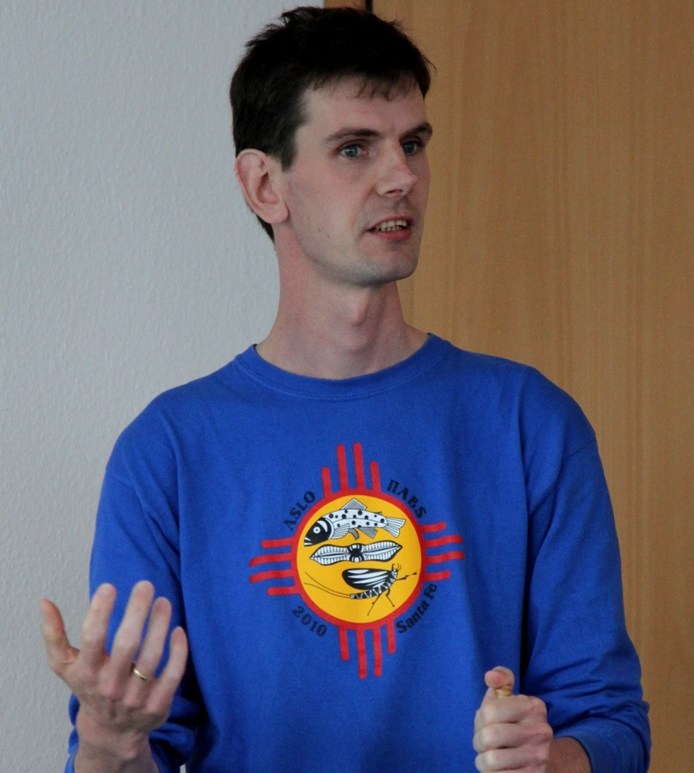
Insights: Martijn Vandegehuchte

In Insights we discover the story behind and beyond a recent publication in Functional Ecology. What inspired the authors to do the research, and how did the project develop leading to the final publication? What implications might their results have on the scientific community and on society?

This week, Bjorn talks to Martijn Vandegehuchte about his paper, Mammalian herbivores affect leafhoppers associated with specific plant functional types at different timescales (plain language summary here.) Martin recently moved from WSL (the Swiss Federal Institute for Forest, Snow and Landscape Research) to Ghent University in Belgium. With his colleagues in Switzerland, Martijn studied multitrophic herbivory interactions in the Swiss National Park.

Continue reading “Insights: Martijn Vandegehuchte”

Tuesday Tasters: 28/11/2017

Recently accepted in Functional Ecology, a very interesting paper describing environmental conditions as an important determinant for the phenology of bird plumage. Nature Ecology & Evolution last week published a paper that shows that the effects of biodiversity on ecosystem multifunctionality increase with increasing number of functions. These findings are in stark contrast with a paper published just over 5 months earlier, which makes the … Continue reading Tuesday Tasters: 28/11/2017

Insights: Angela Prendin

In Insights we discover the story behind a recent publication in Functional Ecology: what inspired the authors to do the research, how did the project develop and what wider impact might the work have?

DSCN2192This week Bjorn talks to Angela Prendin about her article,  Axial xylem architecture of Larix decidua exposed to CO2 enrichment and soil warming at the tree line. Angela is affiliated with the Department of Land, Environment, Agriculture and Forestry (TESAF) of the University of Padova, Italy. With her collaborators at the Swiss Federal Institute for Forest, Snow and Landscape Research (WSL), she studied the xylem architecture of Larch in response to CO2 fertilisation and soil warming. You can also read the free plain language summary here: The treetop is the hotspot determining growth in larch trees

Continue reading “Insights: Angela Prendin”

Tuesday Tasters: 21/11/2017

Already sideways highlighted by Jennifer last week, Nature Ecology and Evolution have published a list of the 100 articles every ecologist should read. Many critical notes have followed (have a look for yourself); for example on how the list has been compiled, the average age of the listed paper (c. 38 years old), its gender bias, etc. I am excited to read these critiques and … Continue reading Tuesday Tasters: 21/11/2017

Tuesday Tasters: 14/11/17

Bjorn’s away, so this week’s Tuesday Tasters are from me. Researchers used digital animation to examine how the effectiveness of a lizard’s territorial display varies across ecological environments and conditions (with video abstract!) For anyone interested in public engagement, Sense about Science have published a new (and free) guide- grab Public Engagement: a practical guide here.   (Case study is from medicine, but the principles are … Continue reading Tuesday Tasters: 14/11/17

Meet the editors: Lara Ferry, Senior Editor

Lara worked as an Associate Editor on Functional Ecology, before becoming our newest Senior Editor (replacing Duncan Irschick) in October. Hello!  I am very excited to be a part of the FE team in a new way.  My background and training are in Functional Morphology, broadly speaking.  I am interested in novel traits, how they evolve and perform, and their ecological consequences.  I work largely … Continue reading Meet the editors: Lara Ferry, Senior Editor

Tuesday taster: 31/10/2017

Published today in Functional Ecology: a study by Griffiths et al. on the links between traits, demography and species abundance in a predator-prey-resource background a study by Lea et al. describing the use of non-invasive physiological markers to identify the population dynamics in Zebra. And again…consider travelling to ‘Ecology without Borders’ by train. Ecologists need to set the example; one conference paper at the moment … Continue reading Tuesday taster: 31/10/2017