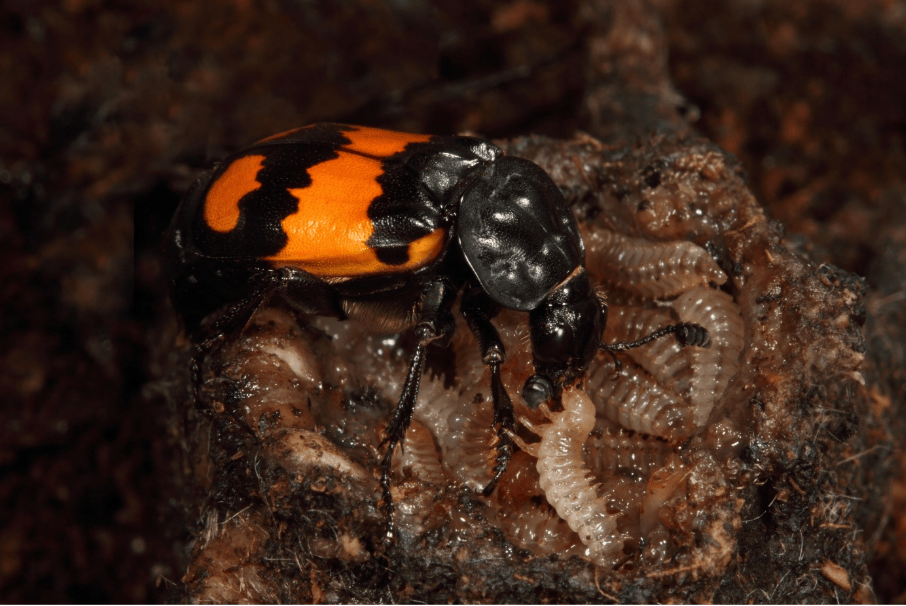
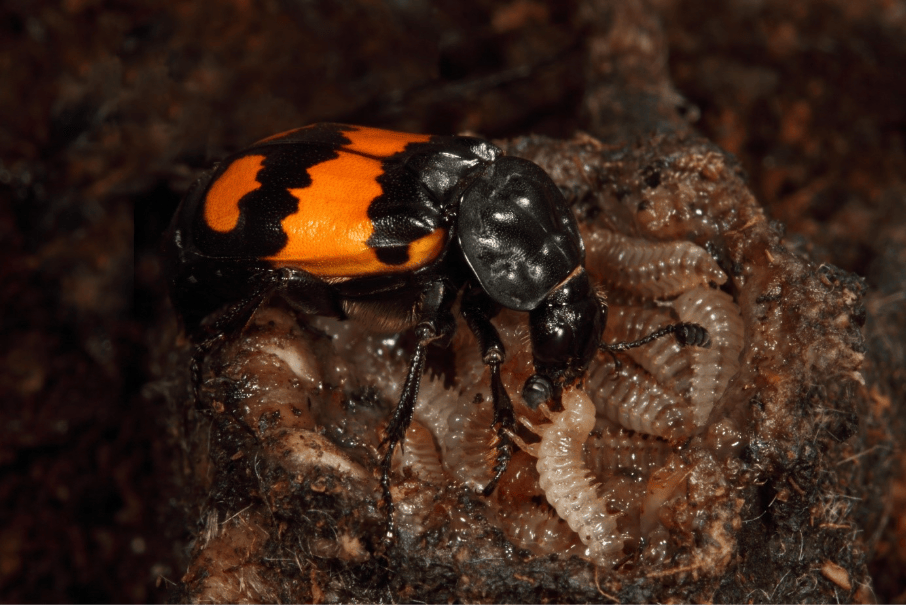
In this ‘Behind the paper’ blog post, author Paul Huber – a PhD student at the University of Bayreuth, Germany – discusses his article “Context-dependent joint buffering of abiotic stress by parental care and sibling interactions“, which was recently published in Functional Ecology. Paul and team tested whether environmental stress increases social interactions in burying beetles. The answer is complex: it depends on who’s present, which stressor occurs and what you measure!
About the paper
A dead mouse is not an obvious place to study climate change. Yet for a burying beetle larva, a small vertebrate carcass is everything, both nursery and a food source. It is also the place where parents, siblings, microbes and environmental conditions interact with each other throughout development. We wanted to know what happens when climate-related stress is added to this already complex social environment and whether environmental stress increases the importance of social interactions within families.
For many animals, social interactions allow them to cope with environmental challenges. Parents, for example, increase access to food, provide protection from predators or pathogens and are able to adjust their care behaviour and help protect their offspring from stressful conditions. But families are more than just parents and offspring. Young animals also interact with their siblings, and these relationships could provide another important source of support. In our paper, we tested whether sibling interactions provide buffering capacities against environmental stress in a similar way to parents. Simultaneously, our experimental design allowed us to test whether sibling interactions are themselves interrupted or altered by changes in environmental conditions.
To answer these questions, we turned to the burying beetle Nicrophorus vespilloides, the most common burying beetle species here in Germany, where the study was conducted. Burying beetles are fascinating organisms because family life differs greatly among species, ranging from almost complete independence from parents to a strong reliance on parental care. Over the past few years, our laboratory has become particularly interested in a different, and often overlooked, component of family life: sibling interactions. Our work, alongside that of others, has shown that larvae can benefit from developing alongside siblings, even though siblings are traditionally viewed as competitors. These findings led us to wonder when the benefits of sibling interactions matter most. Environmental stress seemed like an obvious place to look, particularly as climate change is increasing the importance of understanding how animals respond to extreme conditions. If interactions among siblings help larvae during development, then perhaps their benefits become even more important when temperatures rise, cold snaps occur, or resources become more difficult to exploit.
About the research
We followed larval development in the lab, tracking growth and survival throughout development under a range of challenging environmental conditions designed to simulate heatwaves, cold snaps, droughts and floods. Burying beetle larvae develop remarkably quickly, spending only around five days on the carcass before leaving for pupation. This allows us to follow offspring throughout their entire larval development. We initially expected that social interactions would help offspring cope with harsher environmental conditions and thereby buffer them against environmental stress. The results, however, turned out to be considerably more complicated. While parental care provided benefits across conditions, the effects of siblings were strongly context-dependent. Under some conditions, parents and siblings worked together to buffer offspring against environmental stress. Yet in other situations the same environmental challenge reduced the benefits of sibling interactions and, in fact, likely increased resource competition. Rather than finding a simple pattern in which environmental stress consistently promoted or disrupted cooperation, we found that the effects of social interactions depended strongly on the type of environmental stress and the social environment in which offspring developed. Indeed, one of the biggest surprises came from the soil moisture experiment. Despite spending most of their development underground, larvae were remarkably resilient to changes in moisture. However, this does not necessarily mean that climatic extremes such as droughts and floods are unimportant for insects. Burying beetle larvae develop on a carcass, which provides its own source of moisture and may partly buffer them against changes in the surrounding soil. Other stages of the insect lifecycle, such as the egg or pupate stage, develop directly in the soil and are therefore likely to be considerably more sensitive to extremely dry or wet conditions.
Climate change is often discussed in terms of direct physiological effects. Our study suggests that changes in temperature and moisture may also reshape the social interactions that animals rely on. Importantly, these social effects cannot be understood by studying parents or siblings in isolation. Instead, the consequences of environmental change emerge from the interaction between multiple family members and the environments they experience. These findings highlight that predicting species responses to climate change requires considering not only how individuals respond to environmental stress, but also how environmental change alters social interactions within families.
About the author
I am currently finishing my PhD at the Evolutionary Animal Ecology department at the University of Bayreuth in Germany and submitted my PhD thesis just a few days ago. Throughout my PhD, I have investigated the consequences of sibling isolation and the role of sibling cooperation in the early evolution of social and family life.
My interest in biology started early. I grew up in a family with a strong connection to the natural sciences: my father studied biology and my mother geoecology, both at the same university where I am now completing my PhD. In many ways, this meant that long before I knew what a PhD was, I was already being exposed to the kinds of questions that would later shape my own research. Looking back, it is perhaps not surprising that I eventually returned to the very same place years later as a PhD student, which feels like a rather natural continuation of that journey. Later, two books in particular A guided tour of the living cell by Christian de Duve and The selfish gene by Richard Dawkins further fuelled my interest in molecular and evolutionary biology. Combined with a broader fascination for nature, animals and behavioural biology, these interests eventually led me to the Department of Evolutionary Animal Ecology. There, I have been able to combine my diverse interests of biology spanning from molecular biology, behavioural biology, ecology and applied topics such as climate change.
When I’m not working with the beetles in the lab, I’m usually outdoors. Currently I’m working towards my glider pilot licence (fortunately, gliding is an environmentally friendly form of aviation), and I also enjoy spending time in nature photographing wildlife.

