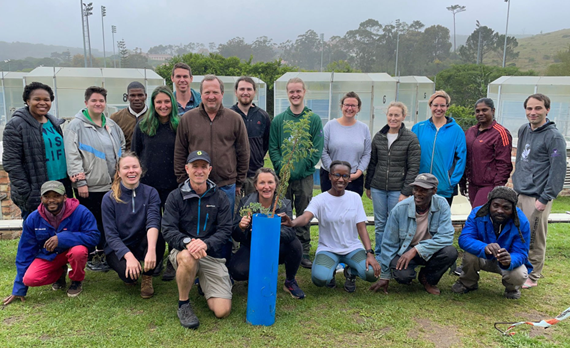
In this ‘Behind the Paper’ post, author Edith Singini – a plant ecophysiologist in the Department of Botany at Rhodes University, South Africa – discusses the paper “Savanna soil carbon accrual occurs through particulate organic matter from grass rather than tree biomass, regardless of atmospheric CO2 levels“, which was recently published in Functional Ecology. Edith explores how grasses and trees influence soil organic carbon under current and future atmospheric CO2 conditions, discusses cautiously interpreting the findings of pot experiments, and shares the importance of being patient with the process.
About the paper
When people think about carbon storage, trees are often the first thing that comes to mind. Trees are visible, large, and easy to imagine as climate allies. But savannas tell a more complicated and much more interesting story. In these ecosystems, a large part of the carbon story happens belowground, hidden beneath the grass layer, in roots, soil organic matter, and the interactions between plants and soil.
Our recent paper in Functional Ecology, led by Dr Heidi-Jayne Hawkins, asks a timely question: in savannas: where does soil carbon come from, and do trees or grasses contribute more to this hidden carbon pool? The study, titled “Savanna soil carbon accrual occurs through particulate organic matter from grass rather than tree biomass, regardless of atmospheric CO2 levels”, explored how grasses and trees influence soil organic carbon under current and future atmospheric CO2 conditions.
This question matters because savannas are increasingly framed as opportunities for enhanced carbon storage, based on the assumption that greater tree cover will increase carbon stocks. Consequently, some savannas have been targeted by tree-planting initiatives, while savannas broadly are undergoing native woody thickening driven by rising atmospheric CO2 and changing disturbance regimes. However, savannas are not degraded forests awaiting restoration by tree establishment. They are ancient grassy ecosystems, shaped by fire, herbivory, rainfall variability, and the long-term coexistence of grasses and trees. Furthermore, increasing tree cover threatens many ecosystem services provided by savannas, such as forage for grazing and a biodiversity reliant on an open canopy. Although increasing tree cover may raise aboveground woody biomass, it does not necessarily mean that belowground carbon storage will increase in the same way.
To test this, we grew five common C3 nitrogen-fixing savanna tree species and a widespread savanna C4 grass Themeda triandra in different combinations at the Rhodes University Elevated CO2 Facility in Makhanda, South Africa. Plants were exposed to ambient (approximately 400 ppm) or elevated (approximately 550 ppm) CO2, allowing us to compare soils from trees alone, grasses alone, and trees growing with grasses.
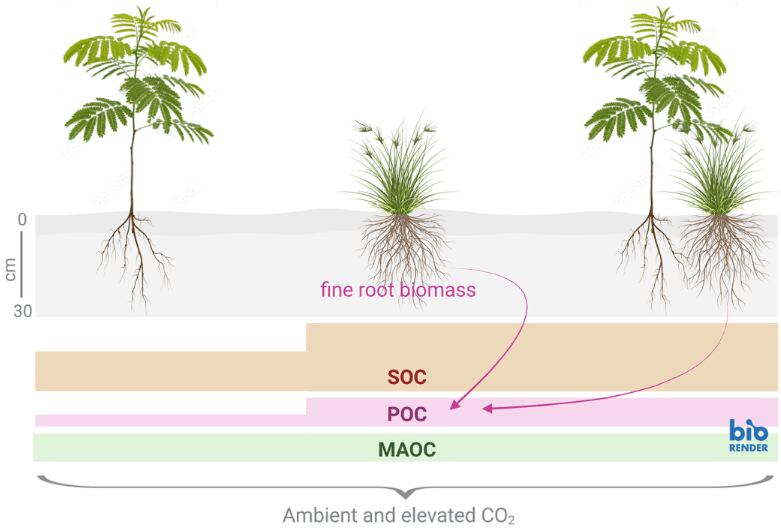
The main message was clear: grasses mattered. Soils containing grasses had more soil organic carbon and nitrogen than soils with trees alone. In fact, soil planted with both grasses and trees had about 10% more carbon and 8% more nitrogen than soil with trees only. Isotope analyses also suggested that much of the soil carbon was grass-derived. Importantly, this pattern remained consistent regardless of atmospheric CO2 levels.
One of the most interesting findings was not only that grasses contributed strongly to soil carbon, but also how that carbon was stored. We often think of mineral-associated organic carbon as a particularly important and persistent soil carbon pool. However, in this sandy savanna soil, carbon accumulation was more strongly linked to occluded particulate organic carbon. This suggests that savanna soils may store carbon through mechanisms that differ from those described in many temperate grasslands. Understanding this better matters if we are to model how savannas respond to climate change.
The broader message is important for climate and conservation. If we focus only on trees, we risk overlooking the carbon value of grassy ecosystems. Our findings support the idea that conserving savannas as grassy biomes can contribute to both climate and biodiversity goals. In other words, protecting the grass layer is not separate from climate action; in savannas, it may be central to it.
About the research
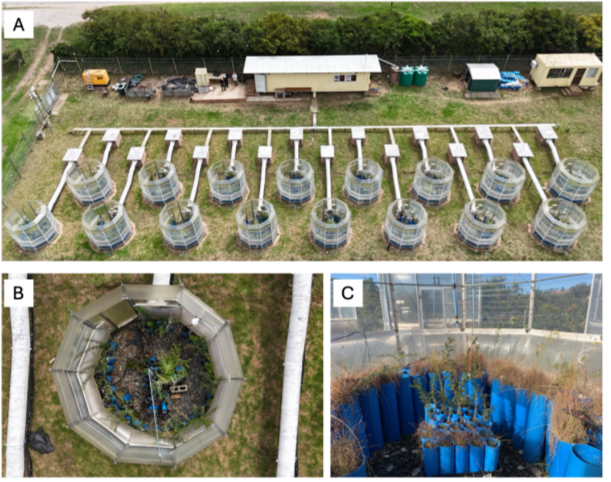
This work was conducted at the Rhodes University Elevated CO2 Facility, a research facility designed to study how savanna plants respond to current and future atmospheric CO2 conditions. The experiment used open-top chambers, which allowed the research team to grow plants under controlled CO2 treatments while still exposing them to natural outdoor conditions.
The experiment was both exciting and labour-intensive. Plants were grown in pots containing local savanna soil. The soil was left unsterilised so that natural soil organisms, including mycorrhizal fungi and rhizobia, could remain part of the system. Grasses were established before tree seedlings, mimicking the situation in natural savannas, where tree seedlings often recruit into an already established grass layer.
After about 30 months, while the trees were still in the young establishment stage, the plants and soils were harvested. This stage was important because young trees are especially sensitive to competition with grasses for water and nutrients, and their early growth can influence whether they survive and eventually establish in savannas. Aboveground plant biomass was collected, and the soil columns were carefully separated into 10 cm sections. Roots, nodules, and soil samples were then separated, dried, weighed, and processed. The soil was analysed for different carbon and nitrogen fractions, including free particulate organic carbon, occluded particulate organic carbon, mineral-associated organic carbon, and dissolved organic carbon. Stable carbon isotopes were used to help trace whether soil carbon was more likely to come from C3 trees or C4 grasses.
Like many ecological experiments, this study also came with challenges. Pot experiments allow strong control over treatments, but they cannot capture every part of a natural savanna. In the field, rooting depth, fire, herbivory, rainfall variation, and long-term soil processes all influence carbon cycling. The isotope work also required careful interpretation because the elevated CO2 source influenced plant and soil carbon signatures. The team therefore interpreted the findings cautiously, focusing on the strong overall pattern rather than overclaiming exact carbon contributions.
The result that stood out most was the strength of the grass signal. It is easy to assume that trees are the main contributors to carbon storage because they are visually dominant and store carbon in woody tissues. But this study showed that grasses, through their roots and contributions to soil organic matter, can play a major role in the formation of savanna soil carbon. Another fascinating finding was the important role of occluded particulate organic carbon. This result reminds us that carbon storage varies across ecosystems. Savannas have their own dynamics, and we need more studies that focus specifically on grassy biomes rather than applying assumptions developed mostly from forests or temperate grasslands.
The next step is to test these patterns across more natural field conditions and over longer timeframes. We need to understand how soil texture, rainfall, fire, grazing, woody thickening, and different grass and tree communities influence soil carbon fractions. This is especially important because savannas are under pressure from both land-use change and climate change. If carbon models and the policies responding to them are to be effective, they must be based on how ecosystems actually function.
About the author
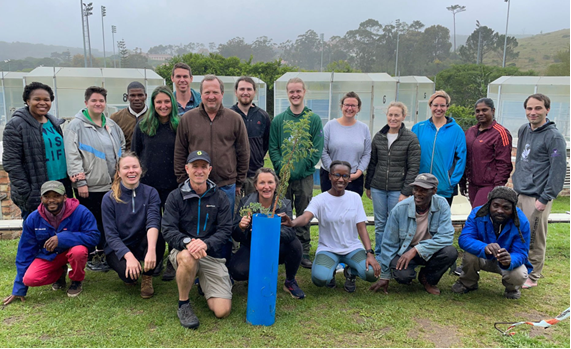
I am Dr Edith J. Singini, a plant ecophysiologist in the Department of Botany at Rhodes University, South Africa. My research focuses on how plants respond to environmental change, particularly rising atmospheric CO2, drought, fire, and woody encroachment in savanna ecosystems. As part of the author team, the study connects closely with my own interest in how plant physiological responses scale up to shape ecosystem-level processes. My journey into ecology began with a curiosity about how plants survive in harsh and variable environments, and this has grown into a broader interest in plant resilience, savanna functioning, and the hidden mechanisms that allow plants to persist under changing climates. My current scientific obsession is understanding how grasses and trees respond differently to elevated CO2 and water limitation, and how these responses may shape the future of savannas. Outside of research, I enjoy running, photography, travelling, and finding moments to slow down beyond deadlines, data, and manuscripts. Like many early-career researchers, I have had to navigate funding uncertainty, limited resources, and the pressure to balance teaching, research, supervision, writing, and collaboration, but these challenges have taught me the value of persistence, mentorship, and supportive scientific communities. If I could give one piece of advice to my younger self, it would be to be patient with the process: science takes time, confidence grows slowly, and you do not need to have everything figured out before you begin.
Acknowledgements
This work was supported by the Natural Environment Research Council and the Friedman Family Foundation. The study was a collaborative effort involving Conservation South Africa, the University of Cape Town, Rhodes University, the University of Sheffield, the University of Michigan, the University of Edinburgh, the Royal Botanic Garden Edinburgh, and the University of the Witwatersrand. We thank everyone involved in maintaining the Rhodes University Elevated CO2 Facility, growing and harvesting the plants, processing the soil samples, analysing the data, and shaping the final paper.

