
In this ‘Behind the Paper’ blog post author Thayara S. Carrasco – a a postdoc at the University of São Paulo, Brazil, explores the paper “Long-term changes in functional diversity and its implications for mammalian conservation and ecological restoration in a grassland ecosystem”, published in Functional Ecology. Thayara discusses the ecological characteristics and functions of species across different time periods in the Brazilian Pampa, the challenges of working across the fossil record, and the importance of maintaining constant exchange.
About the paper
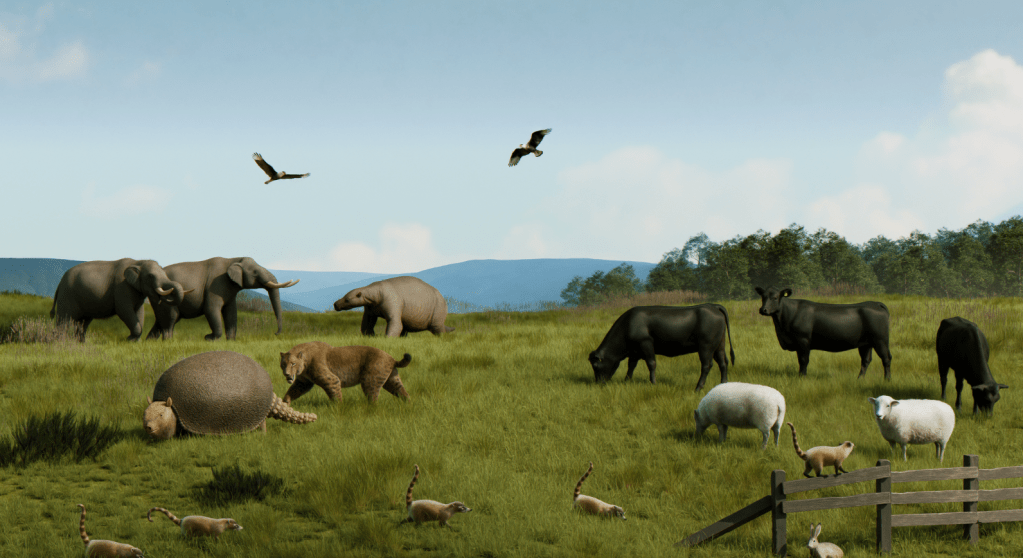
From the Pleistocene, about 10,000 years ago, to the present day, the world has suffered a defaunation of large to megamammals, collectively known as the ‘megafauna’. It may seem like a long period of time from a human perspective. However, probably almost every extant mammal species has also lived during that time or even inhabited the same environments as the megafauna did. Some plants may even exhibit what we call the ‘megafaunal dispersal syndrome’: characteristics that evolved when megaherbivores were diverse and abundant in the past. Indeed, giant sloths, glyptodonts, giant armadillos, mastodons, camelids, macrauchenias, toxodonts, among others, were likely key species in South American grasslands.
Given the loss of the megafauna and the emergence of novel ecosystems and mammalian communities that include livestock and alien species, we asked whether domesticated ungulates are able to fulfill these lost ecological functions. To answer these questions, we adopted a functional diversity approach in order to synthesize the ecological characteristics and functions of each species across different time periods in the Brazilian Pampa.
What we found is that livestock species, such as bovids, cannot be considered ecological substitutes for any of the extinct species from the studied region. Conversely, the alien spotted deer (Axis axis), which is included in population control programs, as well as domestic horses, may be important in fulfilling lost ecological functions. Still, the functional diversity lost is poorly compensated in the modern scenario.
Although our study indicates that the ecosystem may be experiencing impacts that were not present even in the pre-extinction scenario, we emphasize that economic and social factors should be taken into account. An area used for livestock is still better than monoculture, but the Pampa needs more protected areas to support viable populations of the giant otter, Pteronura brasiliensis; marsh deer, Blastocerus dichotomus; white-lipped peccary, Tayassu pecari; lowland tapir, Tapirus terrestris; and giant anteater, Myrmecophaga tridactyla, which were identified as endangered species that are functionally unique and specialized to this ecosystem.
About the research
Working with current and past diversity implies using different lines of evidence. While it is possible to obtain different types of evidence from the ecology, behavior, morphology, and physiology of living forms, for extinct ones, we usually only have their bones from which to obtain such information. Besides that, the fossil record is inherently incomplete. I (and surely other paleontologists) usually like to say that, “If the history of life is a movie, then the fossil record is a series of still images from this film, but spaced irregularly from each other”. It means that we only have access to frames of that history.
Given such limitations, we had to select characteristics that were available for both extant and extinct species and, at the same time, were informative about their ecological roles. Unfortunately, we are not able to infer the period of activity, living area, or group size of the vast majority of fossil species, but we think that we could reach a reasonable degree of detail and functional discrimination among different functional entities, revealing surprising results.
While I was particularly expecting that our results would indicate that livestock is not a suitable substitute for the megafauna, I was surprised by the result that the spotted deer may replace lost ecological functions. This highlights that the expansion of alien species may be a result of the exploitation of vacant ecological niches, which, therefore, does not imply that they directly compete for resources or necessarily pose a threat to extant native species. The Pleistocene fauna is an example of how natural grasslands can support a high diversity of different herbivores in the absence of human pressure and habitat degradation.
I think that the next steps on this topic should be to collect in situ data about the ecological relationships between the novel herbivores and extant mammalian species. While a macroecological perspective provides valuable insights into key processes, we need finer-scale details to properly delineate conservation strategies.
About the author

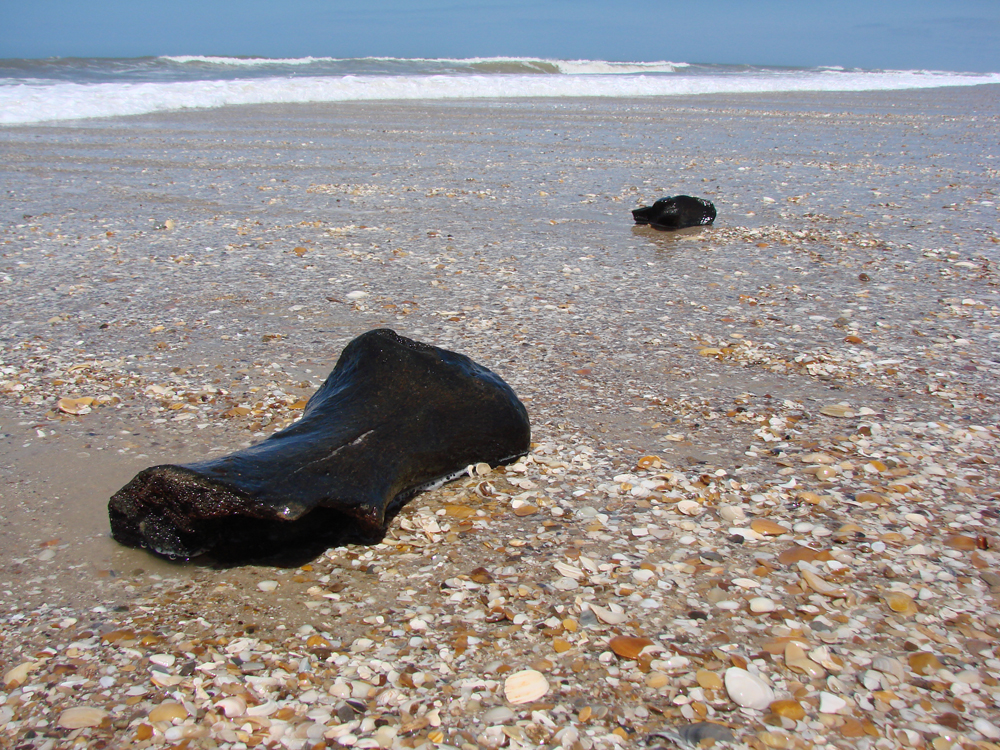
I have always been intrigued, in a certain way, by ecology, the role of each living species and, particularly, by the interspecific relationships that I had seen countless times in documentaries when I was just a child. However, at that time, I wasn’t aware of all the additional information that the fossil record could provide. Being a mammal lover and having grown up in a beach town, I soon became involved in a laboratory of marine mammals, which I consider to have been a period of great professional growth, when I had the opportunity to observe and collect many different species. On the same beach where we weekly collected stranded mammals, it is common for Pleistocene fossils to appear on the foreshore, especially after storms. Intriguingly, those dark and fragmented bones belonged to giant terrestrial mammals that no longer inhabited that place. And suddenly, I was doing my PhD on the ecology of the extinct megafauna. Later, during my postdoc, I learned how all the data and information gathered during my PhD could be useful for the conservation and ecological restoration of extant fauna and their ecosystems through the emerging field of Conservation Paleobiology.
In Brazil, there are many sources of funding, incentives, and scholarships from the government that support academic careers, which allowed me to complete my master’s degree and doctorate, as well as undertake internships abroad. Nevertheless, one of the greatest challenges of being a scientist in Brazil is that we largely depend on positions at universities as professors, while opportunities in research institutes and museums are very limited. As I am currently in a postdoc position, my main concern regarding my scientific career is the uncertainty of obtaining a permanent position at a university. Besides that, I am a very introspective person, a characteristic that makes it difficult to build connections with other researchers and develop a strong professional network. Although curiosity and a love of nature have always been present in my life, which I think are essential qualities for a biologist, it is important to maintain a constant exchange with other researchers for greater professional growth. Thus, my main recommendation for my younger self (and maybe for my current self as well) is to meet people and not be afraid to ask for their help. Science should be collaborative.
Outside of research, I really like to explore new places and, particularly, to walk on the beach (even in winter and on cold mornings or nights). It’s always possible to observe nature in these environments, no matter how urban the beach is. A calm sea after rough weather, seeing what the water has carried onto the sand – different kinds of shells, or even fossils that were formerly submerged. It’s also nice to see how the environment constantly changes. A beach is never the same. I also like to visit art museums to admire all the beautiful things made by human hands. I think that my favorite artist is probably Salvador Dalí, although, when it comes to cinema, I don’t like surrealist works and prefer portrayals of ordinary life.
 Functional Ecologists