Mechanisms and consequences of infection-induced phenotypes: A Functional Ecology and Journal of Animal Ecology cross-journal special feature

In this post, Functional Ecology and Journal of Animal Ecology showcases each article that can be found in our cross-journal special feature on Mechanisms and consequences of infection-induced phenotypes. This collection of studies brings together biologists working on a wide range of host-parasite systems and topics—from molecular biology and animal behaviour to comparative physiology and community ecology—to synthesize our current state of understanding of host-parasite … Continue reading Mechanisms and consequences of infection-induced phenotypes: A Functional Ecology and Journal of Animal Ecology cross-journal special feature

Hana Skálová: Cations make a difference: Soil nutrient patches and fine-scale root abundance of individual species in a mountain grassland

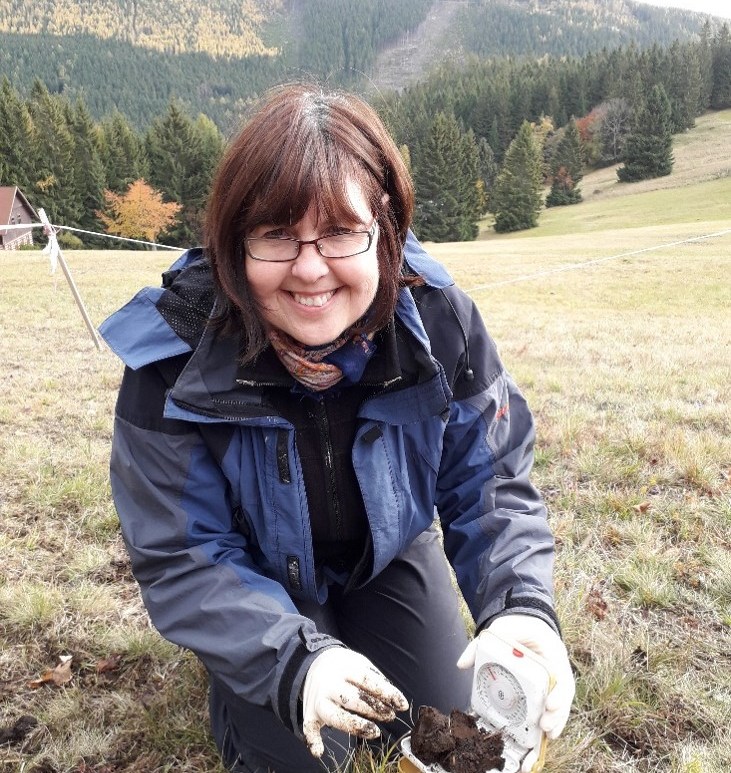
Alt: Stable nutrient patches in the field seem attractive for plant roots In this new post Hana Skálová, from the Institute of Botany in Průhonice (Czech Republic), presents her recently published article “Cations make a difference: Soil nutrient patches and fine-scale root abundance of individual species in a mountain grassland.” She discusses the importance of overlooked nutrients on plant roots, highlights how new technology enables … Continue reading Hana Skálová: Cations make a difference: Soil nutrient patches and fine-scale root abundance of individual species in a mountain grassland

Matthew Krna: Decomposition rates of leaf litter are temperature-independent

In this new post, Matt Krna—then a PhD student at Massey University, New Zealand—discusses his recently published paper in Functional Ecology: Temperature dependency of litter decomposition is not demonstrated under reciprocal transplantation of tussock leaves along an altitudinal gradient. This research follows on from his publication on clarifying carbon sequestration (Krna and Rapson, 2013). In his study of decomposition across a 700 m altitudinal gradient … Continue reading Matthew Krna: Decomposition rates of leaf litter are temperature-independent

Veera Norros: Species of wood-inhabiting fungi display different reproductive and dispersal strategies—which is the winning strategy in changing environments?

In this new post, Finnish Senior Research Scientist, Veera Norros, present her latest work ‘Spore production monitoring reveals contrasting seasonal strategies and a trade-off between spore size and number in wood-inhabiting fungi’. She discusses the importance of season for fungi spore-production, the vulnerability of wood-dependant species, and the challenges to conciliate research and family. About the paper Habitat loss and climate change divide species into … Continue reading Veera Norros: Species of wood-inhabiting fungi display different reproductive and dispersal strategies—which is the winning strategy in changing environments?

Sam Ross: Listening for the answers to fundamental questions

In this new post, Sam Ross—a Postdoc at the Okinawa Institute of Science and Technology Graduate University, Japan—presents his review paper ‘Passive acoustic monitoring provides a fresh perspective on fundamental ecological questions’. He discusses how acoustic monitoring isn’t just for applied ecology and conservation, and some of developments on the horizon. About the paper From a bleary-eyed dawn chorus, to magnificent symphonies of whale song, … Continue reading Sam Ross: Listening for the answers to fundamental questions

Laura Ortiz Díaz: Biological soil crusts and neighbour plants strongly affects annual plants living in gypsum drylands

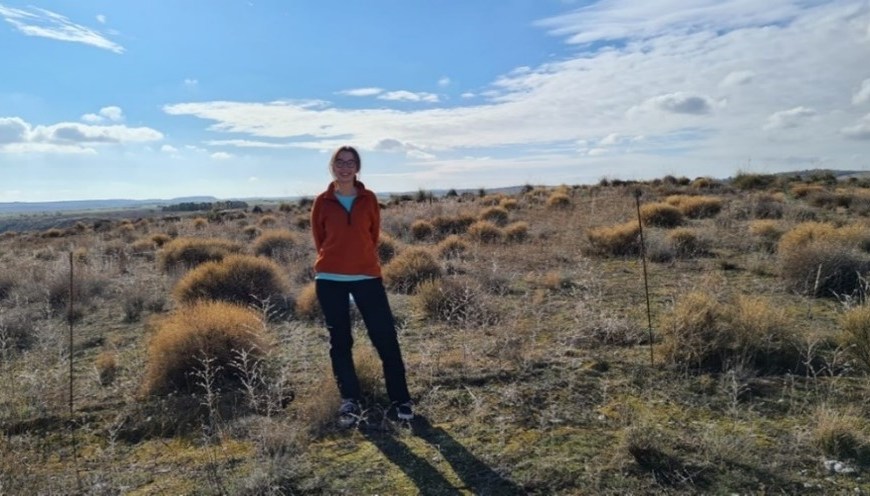
In our latest post, Laura Ortiz Díaz—A PhD student at Universidad Rey Juan Carlos, Spain—presents her new study ‘Functional diversity of experimental annual plant assemblages drives plant responses to biological soil crusts in gypsum systems’. Laura tells us where the idea of the study came from, the importance of biological soil crust for drylands ecology, and how she became hooked on ecology from an early … Continue reading Laura Ortiz Díaz: Biological soil crusts and neighbour plants strongly affects annual plants living in gypsum drylands

Laura Ortiz Díaz: La costra biológica del suelo y las plantas vecinas afectan al establecimiento y desarrollo de las plantas anuales que viven en ambientes yesíferos semiáridos.

En este post Laura Ortiz Díaz, estudiante de doctorado de la Universidad Rey Juan Carlos (España), nos presenta su trabajo ‘Functional diversity of experimental annual plant assemblages drives plant responses to biological soil crusts in gypsum systems’ Laura nos cuenta de dónde surgió la idea del trabajo, la importancia que la costra biológica puede tener en zonas áridas y cómo la ecología le atrapó desde … Continue reading Laura Ortiz Díaz: La costra biológica del suelo y las plantas vecinas afectan al establecimiento y desarrollo de las plantas anuales que viven en ambientes yesíferos semiáridos.

Kristiina Visakorpi: The future of Alpine meadows: Can we predict winners and losers in a warmer climate?

In this new post Kristiina Visakorpi—a postdoc at the Norwegian University of Science and Technology—discusses her last research ‘Eco-physiological and morphological traits explain alpine plant species’ response to warming’. She considers the connections between functional traits and climate change, highlights the importance of eco-physiological traits, and provides some thoughts to fight apathy towards our current environmental crises. About the paper In our paper we investigated … Continue reading Kristiina Visakorpi: The future of Alpine meadows: Can we predict winners and losers in a warmer climate?

Daniel Zuleta: Do small-scale changes in topography affect functional trait variability in an aseasonal Amazon forest?

In our newest post Daniel Zuleta—a postdoc researcher at Smithsonian ForestGEO—presents his last work ‘Interspecific and intraspecific variation of tree branch, leaf, and stomatal traits in relation to topography in an aseasonal Amazon forest’. He presents the huge Amacayacu Forest Dynamics Plot, findings about the major impact that tree size exerts on tree functional traits, and how he changed his interests from forest plantations industry … Continue reading Daniel Zuleta: Do small-scale changes in topography affect functional trait variability in an aseasonal Amazon forest?

Filipa Coutinho Soares: Island bird communities are becoming similar after extinctions and introductions

In this new post, Dr. Filipa Coutinho Soares—a recent Ph.D. graduate from the University of Lisbon, Portugal—discusses her recently accepted paper, “Bird extinctions and introductions are causing taxonomic and functional homogenization in oceanic islands”. About the paper In our paper, we explore if bird extinctions and introductions driven by human activities are causing bird communities of oceanic islands to become taxonomically and functionally homogenized. In … Continue reading Filipa Coutinho Soares: Island bird communities are becoming similar after extinctions and introductions