Daniel Zuleta: Do small-scale changes in topography affect functional trait variability in an aseasonal Amazon forest?

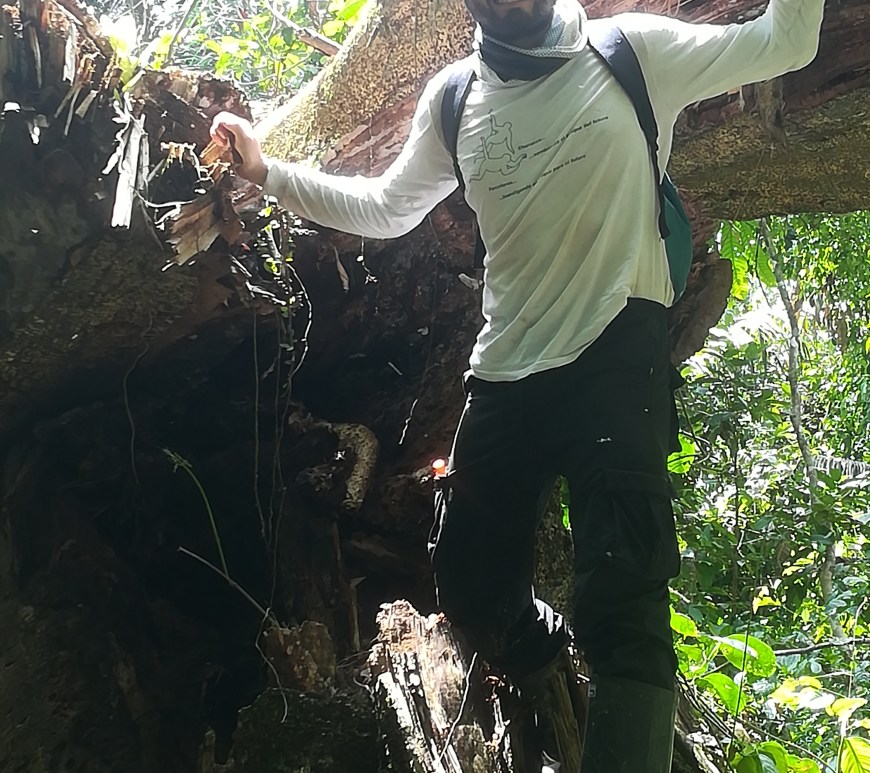
In our newest post Daniel Zuleta—a postdoc researcher at Smithsonian ForestGEO—presents his last work ‘Interspecific and intraspecific variation of tree branch, leaf, and stomatal traits in relation to topography in an aseasonal Amazon forest’. He presents the huge Amacayacu Forest Dynamics Plot, findings about the major impact that tree size exerts on tree functional traits, and how he changed his interests from forest plantations industry … Continue reading Daniel Zuleta: Do small-scale changes in topography affect functional trait variability in an aseasonal Amazon forest?

Luca Carisio: How much nectar is produced when the effect of flower-visiting insects is considered?

About the paper Our paper describes how to estimate the nutritional contribution of plants to pollinators and to other flower-visiting insects. The nutritional contribution of plants to pollinators is usually estimated by measuring—using a mesh bag—the nectar volume produced by flowers isolated for a 24 h period from flower-visiting insects. Many studies adopted this 24 h measure as a proxy of plant nectar production. When … Continue reading Luca Carisio: How much nectar is produced when the effect of flower-visiting insects is considered?

Juliano Morais: What is the fate of coral colonies after death? An Investigation into the erosion of dead coral colonies

In our latest post, Juliano Morais—a PhD candidate at James Cook University, Australia—presents his new work ‘On the fate of dead coral colonies’. In this blogpost, Juliano discusses the importance of erosion for coral reef survival and encourages non-native language speakers to be bold and start a career in ecology.   About the paper Carbonate budgets dynamically balance production and loss of calcium carbonate (CaCO3) … Continue reading Juliano Morais: What is the fate of coral colonies after death? An Investigation into the erosion of dead coral colonies

Filipa Coutinho Soares: Island bird communities are becoming similar after extinctions and introductions

In this new post, Dr. Filipa Coutinho Soares—a recent Ph.D. graduate from the University of Lisbon, Portugal—discusses her recently accepted paper, “Bird extinctions and introductions are causing taxonomic and functional homogenization in oceanic islands”. About the paper In our paper, we explore if bird extinctions and introductions driven by human activities are causing bird communities of oceanic islands to become taxonomically and functionally homogenized. In … Continue reading Filipa Coutinho Soares: Island bird communities are becoming similar after extinctions and introductions

Carla Vázquez González: Deciphering the context-dependency of plant communication: How does drought stress affect plant-plant signalling by volatile organic compounds?

In our latest post, Carla Vázquez González—a postdoctoral researcher from the University of California-Irvine—presents her last work ‘Effect of water availability on volatile-mediated communication between potato plants in response to insect herbivory’. In this post, she sheds new light on how plants communicate to overcome adversity, discusses the striking results in her paper, and shares her thought about the rough path early-career ecologists currently face. … Continue reading Carla Vázquez González: Deciphering the context-dependency of plant communication: How does drought stress affect plant-plant signalling by volatile organic compounds?

Robin Hare: Notes on a pollen-based sexual economy

In our latest blogpost, Dr. Robin Hare, Tutor at the University of Western Australia and Senior Biologist at Bennelongia Environmental Consultants, discusses with us his recently published paper in Functional Ecology: “Evolutionary divergence via sexual selection acting on females in a species with sex role reversal.” About the paper Our paper is about how ecology and evolution uniquely affect females in a species of bushcricket … Continue reading Robin Hare: Notes on a pollen-based sexual economy

Melissa León: Red flowers from the Mediterranean Basin, color strategists.

In the present blogpost Melissa León, PhD student at University Pablo Olavide in Spain, presents her research ‘Unravelling the mystery of red flowers in the Mediterranean Basin: How to be conspicuous in a place dominated by hymenopteran pollinators’. She shows the different methods plants use to attract pollinators, potential evolutionary implications of these methods, and her passion for ecological sciences. A Spanish version of this … Continue reading Melissa León: Red flowers from the Mediterranean Basin, color strategists.

Melissa León: Flores rojas de la Cuenca Mediterránea, estrategas del color.

En este post Melissa León, estudiante predoctoral en la Universidad Pablo de Olavide de Sevilla, presenta su artículo ‘Desvelando el misterio de las flores rojas de la cuenca mediterránea: ¿Cómo ser llamativas en un ecosistema donde predominan los himenópteros?’ Aquí nos muestra los distintos métodos de las plantas para atraer polinizadores, las implicaciones evolutivas de estos métodos, y su pasión por la ecología. Una versión … Continue reading Melissa León: Flores rojas de la Cuenca Mediterránea, estrategas del color.

María Natalia Lescano: The complex role of bottom-up cascading effects: Excess nutrients make aphids less attractive to mutualistic ants

In our latest post, María Natalia Lescano, researcher at CONICET and University of Comahue, discusses their paper ‘Excessive nutrient input induces an ecological cost for aphids by modifying their attractiveness towards mutualist ants’, whilst also showcasing their fantastic tri-trophic study system and discussing the importance of cascading effects in ecosystems. About the paper Ecological stoichiometry considers the balance of energy and elements on organisms and … Continue reading María Natalia Lescano: The complex role of bottom-up cascading effects: Excess nutrients make aphids less attractive to mutualistic ants

Natalie K. Rideout: Sifting through the wetland muck to examine links between habitat, disturbance and biodiversity

In our new post, Natalie Rideout from the Canadian River Institute at the University of New Brunswick, presents her MsC research in the paper ‘Environmental filtering of macroinvertebrate traits influences ecosystem functioning in a large river floodplain’. She highlights the importance of floodplains for ecological research, emphasises the need for teamwork to answer research questions, and shares her passion for the natural world. About the … Continue reading Natalie K. Rideout: Sifting through the wetland muck to examine links between habitat, disturbance and biodiversity