Veera Norros: Species of wood-inhabiting fungi display different reproductive and dispersal strategies—which is the winning strategy in changing environments?

In this new post, Finnish Senior Research Scientist, Veera Norros, present her latest work ‘Spore production monitoring reveals contrasting seasonal strategies and a trade-off between spore size and number in wood-inhabiting fungi’. She discusses the importance of season for fungi spore-production, the vulnerability of wood-dependant species, and the challenges to conciliate research and family. About the paper Habitat loss and climate change divide species into … Continue reading Veera Norros: Species of wood-inhabiting fungi display different reproductive and dispersal strategies—which is the winning strategy in changing environments?

Pedro Jaureguiberry: Las plantas de regiones con diferentes historias de incendios responden al fuego y se queman de manera diferente

En este nuevo post Pedro Jaureguiberry—Investigador Adjunto del IMBIV (CONICET-UNC), Argentina—presenta su último trabajo ‘A three-dimensional approach to general plant fire syndromes’. Aquí destaca la importancia de considerar rasgos funcionales de efecto en ecología del fuego, hipotetiza qué rasgos tendrá la vegetación en función de la historia regional de incendios y muestra su interés por la conexión entre el ser humano y la naturaleza. An … Continue reading Pedro Jaureguiberry: Las plantas de regiones con diferentes historias de incendios responden al fuego y se queman de manera diferente

Pedro Jaureguiberry: Plants from regions with different fire histories respond to fire and burn differently

In this new post Pedro Jaureguiberry—Adjunct Researcher at IMBIV (CONICET-UNC)—Argentina, presents his last work ‘A three-dimensional approach to general plant fire syndromes’. He highlights the importance of effect traits for fire ecology, hypothesizes plant traits based on regional fire history, and shows his interest in the connections between humans and nature.  Una versión en Español de esta publicación está disponible aquí! About the paper Fire … Continue reading Pedro Jaureguiberry: Plants from regions with different fire histories respond to fire and burn differently

Sam Ross: Listening for the answers to fundamental questions

In this new post, Sam Ross—a Postdoc at the Okinawa Institute of Science and Technology Graduate University, Japan—presents his review paper ‘Passive acoustic monitoring provides a fresh perspective on fundamental ecological questions’. He discusses how acoustic monitoring isn’t just for applied ecology and conservation, and some of developments on the horizon. About the paper From a bleary-eyed dawn chorus, to magnificent symphonies of whale song, … Continue reading Sam Ross: Listening for the answers to fundamental questions

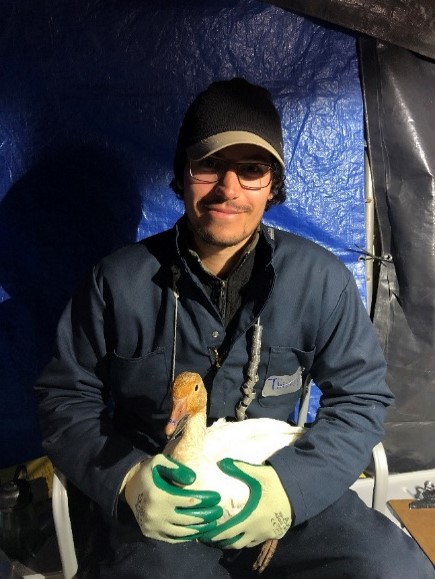
Thierry Grandmont: Experimental stress in migration influences decision to breed or not

In this new post, Thierry Grandmont—a Ph.D. candidate at Laval University, Quebec, Canda—discusses with us his recently accepted paper, “Should I breed or should I go? Manipulating individual state during migration influences breeding decisions in a long-lived bird species.” He talks about the link between breeding and migration, challenges (and opportunities!) of conducting research during the pandemic, and how birdwatching was a formative experience. Une … Continue reading Thierry Grandmont: Experimental stress in migration influences decision to breed or not

Thierry Grandmont: Le stress expérimental dans la migration influence la décision de se reproduire ou non

Dans cette nouvelle publication, Thierry Grandmont, un étudiant au doctorat à l’Université Laval, discute de son article récemment accepté “Should I breed or should I go? Manipulating individual state during migration influences breeding decisions in a long-lived bird species”. Il discute du lien entre la reproduction et la migration, des défis (et opportunités!) d’effectuer de la recherche pendant la pandémie et de comment l’observation d’oiseaux … Continue reading Thierry Grandmont: Le stress expérimental dans la migration influence la décision de se reproduire ou non

Tao Sun: A noteworthy element when assessing the effect of habitat loss on plant reproduction: The movement strategy of pollinators

In our new post, Professor Tao Sun—from the School of Environment, Beijing Normal University, China—presents his latest work ‘Density-dependent dispersal strategy of pollinator moderates the adverse effect of habitat loss on plant reproduction: An integrated model based on pollinators’ behavioural response’. He discusses the importance of looking at details to understand animal behavior, shows the development of his model, and elucidates his research interest in … Continue reading Tao Sun: A noteworthy element when assessing the effect of habitat loss on plant reproduction: The movement strategy of pollinators

Interested in becoming a BES Associate Editor?

The seven British Ecological Society journals are currently?looking for ecologists and practitioners to join their editorial boards! See here for more information and how to apply (deadline: 28th February 2023). Read on for details about the role and insights from some of our current Associate Editors: 🔎 THE ROLE Being an Associate Editor (AE) involves making initial assessments on the suitability of manuscripts, securing appropriate… Continue reading Interested in becoming a BES Associate Editor?

Alice Risely: Why time of day matters when studying host-microbe interactions

In our new post, Dr. Alice Risely—who will start a Research Fellowship at Salford University, UK in March—discusses her recently published paper, “Circadian rhythms of hosts and their gut microbiomes: implications for animal physiology and ecology.” Alice elucidates on the link between gut microbiomes and circadian rhythms, ideas for future research, and reminisces on her childhood fascination with animals. About the paper So many processes … Continue reading Alice Risely: Why time of day matters when studying host-microbe interactions

Géraldine Hildbrand: Why some plants are better able to adapt to climate change

In this new post, Géraldine Hildbrand—Scientific collaborator, BFH-HAFL, Switzerland—presents her latest work ‘Above- and below-ground responses to experimental climate forcing in two forb species from montane wooded pastures in Switzerland’. She highlights the importance of ecophysiological traits, discusses the relevance of plasticity to cope with environmental changes, and explains how she can balance research while moving to teaching. About the paper It is undeniable that … Continue reading Géraldine Hildbrand: Why some plants are better able to adapt to climate change