Functional Ecology welcomes 20 new Associate Editors

Functional Ecology is delighted to announce 20 new Associate Editors who have joined the Editorial Board following our latest open call across all seven BES journals. Find out more about the expertise behind Functional Ecology’s newly onboarded Associate Editors below! Associate Editor Profiles 1. Iveren Abiem Department of Plant Science and Technology, University of Jos, Nigeria Iversen is a forest ecologist and conservation biologist studying … Continue reading Functional Ecology welcomes 20 new Associate Editors

Gianalberto Losapio: A roadmap for restoring functional ecosystems using ecosystem engineers

Dr. Gianalberto Losapio from the University of Lausanne and University of Milan discusses with us their recently accepted paper “Monitoring and modelling the effects of ecosystem engineers on ecosystem functioning,” as well as their interest and roots in the field of ecology. About the paper Our review paper aims at developing a toolkit for the assessment of ecosystem functioning, which includes ecological processes arising from … Continue reading Gianalberto Losapio: A roadmap for restoring functional ecosystems using ecosystem engineers

Jackson Drew: Aging in the Arctic—Insights from a study on woody shrubs

In this new post, Jackson Drew—a PhD candidate in Alaska—presents his work ‘Age Matters: older Alnus viridis ssp. fruticosa are more sensitive to summer temperatures in the Alaskan Arctic‘. Here he shows the importance of age for plant growth, discusses the importance of global change for vegetation, and tells us how Alaska is not as cold as it used to be. About the paper To … Continue reading Jackson Drew: Aging in the Arctic—Insights from a study on woody shrubs

Austin Allison: Ground squirrels hibernate to avoid predation, but not at the expense of reproductive opportunities

Austin Allison—a PhD student at Colorado State University and recent MS graduate from the University of Idaho—discusses his recently accepted paper: “Why hibernate? Tests of four hypotheses to explain intraspecific variation in hibernation phenology.” About the Paper Why do animals hibernate? I—like many people—assumed I knew the answer to that question. Animals obviously hibernate to avoid seasonally unsuitable environmental conditions such as freezing temperatures and … Continue reading Austin Allison: Ground squirrels hibernate to avoid predation, but not at the expense of reproductive opportunities

Laura Figueroa: Bees, flowers, and beyond—One researcher’s path to understanding and promoting pollinator health

Dr. Laura Figueroa—currently an NSF Postdoctoral Research Fellow and incoming Assistant Professor in the Department of Environmental Conservation at the University of Massachusetts, Amherst, USA—shares her recently accepted paper: “Sunflower spines and beyond: mechanisms and breadth of pollen that reduce gut pathogen infection in the common eastern bumble bee.” About the paper Flowers provide foraging bees with a broad diversity of key resources, including pollen … Continue reading Laura Figueroa: Bees, flowers, and beyond—One researcher’s path to understanding and promoting pollinator health

Georgia Hernández Corrales: Closely related tropical herbs have similar tolerance to high temperatures

In our newest post Georgia Hernández Corrales—PhD candidate at University of Connecticut, USA—presents her work ‘Evolutionary history constrains heat tolerance of native and exotic tropical Zingiberales’. She discusses the importance of evolutionary history for plant physiology, shares the beauty of tropical forests, and highlights the importance of mentorship for a happy start in research. About the paper Lowland forests are one of the warmest ecosystems … Continue reading Georgia Hernández Corrales: Closely related tropical herbs have similar tolerance to high temperatures

Natalie Rideout: The floodplain wetland puzzle

In this new post, Natalie Rideout, a new ecological researcher working at the University of New Brunswick, Canada, discusses her paper: Environmental filtering of macroinvertebrate traits influences ecosystem functioning in a large river floodplain—recently shortlisted for the 2022 Haldane Prize for Early Career Researchers. Natalie has already provided a blogpost which discusses the particulars of her paper and research experience. Check it out HERE! About … Continue reading Natalie Rideout: The floodplain wetland puzzle

Manjunatha H. Chandregowda: Grasses adjust their root traits during drought to reduce the negative impacts on aboveground productivity

In this new post, Manjunatha H. Chandregowda—a new ecological researcher working at the Hawkesbury Institute for the Environment, Western Sydney University, Australia—discusses his paper: Root trait shifts towards an avoidance strategy promote productivity and recovery in C3 and C4 pasture grasses under drought—recently shortlisted for the 2022 Haldane Prize for Early Career Researchers. About the research Human disruption of global carbon and nitrogen cycles has … Continue reading Manjunatha H. Chandregowda: Grasses adjust their root traits during drought to reduce the negative impacts on aboveground productivity

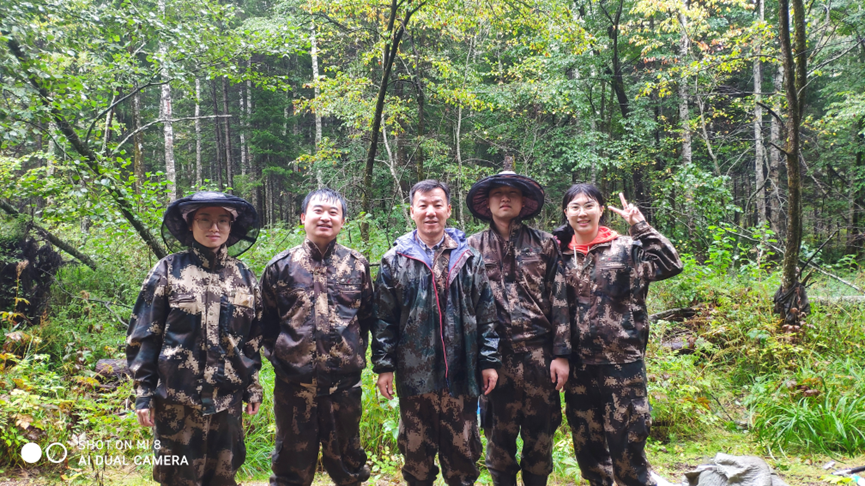
Yankun Zhu: A long-term precipitation manipulation field experiment in a shrub-encroached grassland in Inner Mongolia, China

In this new post, Yankun Zhu—Associate Professor at Sanming University, China—discusses his paper: Increased precipitation attenuates shrub encroachment by facilitating herbaceous growth in a Mongolian grassland—recently shortlisted for the 2022 Haldane Prize for Early Career Researchers. About the paper Widespread shrub encroachment is profoundly impacting the structures and functions of global drylands, and precipitation change is assumed to be one of the most critical factors … Continue reading Yankun Zhu: A long-term precipitation manipulation field experiment in a shrub-encroached grassland in Inner Mongolia, China

Laura Bellec: Inside the feeding behavior of a pollinivore

In this new post, Laura Bellec—a new ecological researcher working at the Univ Rennes 1, Rennes, France—discusses her paper: Factors driving the within-plant patterns of resource exploitation in a herbivore—recently shortlisted for the 2022 Haldane Prize for Early Career Researchers. About the paper Animals need to find food to survive and grow; however, searching for food is energetically expensive. Thus, animals have evolved strategies that … Continue reading Laura Bellec: Inside the feeding behavior of a pollinivore