Alyssa Kullber: Aclimatación temporal de la tolerancia termal en árboles a lo largo del Río Hirviente en la Amazonía.


Sobre el artículo Es posible que las plantas tropicales sean particularmente vulnerables a las altas temperaturas asociadas con el cambio climático porque han evolucionado bajo condiciones relativamente estables y no estacionales. La investigación de la vulnerabilidad de las plantas tropicales a las altas temperaturas es un gran reto, especialmente en las tierras bajas, donde simplemente no hay una analogía del clima más caluroso del futuro, … Continue reading Alyssa Kullber: Aclimatación temporal de la tolerancia termal en árboles a lo largo del Río Hirviente en la Amazonía.
Alyssa Kullberg: Seasonal acclimation of thermal tolerance in trees growing alongside the Boiling River in the Amazon

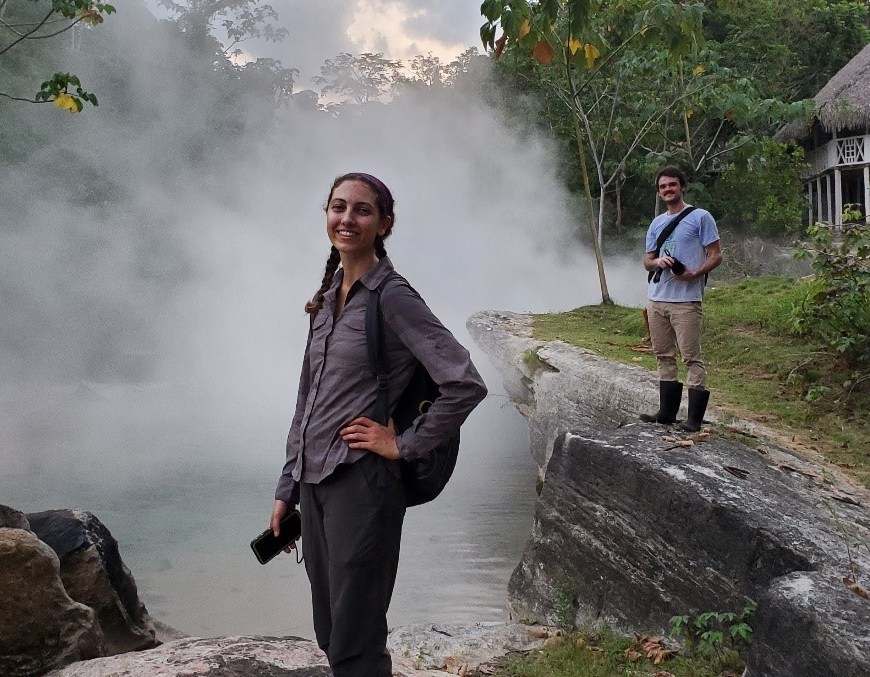
In our last post Alyssa Kullberg, postdoc at WSL in Lausanne, presents her work ‘Seasonal acclimation of photosynthetic thermal tolerances in six woody tropical species along a thermal gradient’. Here, she discusses the need to study warming, shows her incredible experimental system and shares her road in ecology from her early concerns about climate change.   A Spanish Translation of this blog post is available here. … Continue reading Alyssa Kullberg: Seasonal acclimation of thermal tolerance in trees growing alongside the Boiling River in the Amazon

Austin Allison: Ground squirrels hibernate to avoid predation, but not at the expense of reproductive opportunities

Austin Allison—a PhD student at Colorado State University and recent MS graduate from the University of Idaho—discusses his recently accepted paper: “Why hibernate? Tests of four hypotheses to explain intraspecific variation in hibernation phenology.” About the Paper Why do animals hibernate? I—like many people—assumed I knew the answer to that question. Animals obviously hibernate to avoid seasonally unsuitable environmental conditions such as freezing temperatures and … Continue reading Austin Allison: Ground squirrels hibernate to avoid predation, but not at the expense of reproductive opportunities

Georgia Hernández Corrales: Closely related tropical herbs have similar tolerance to high temperatures

In our newest post Georgia Hernández Corrales—PhD candidate at University of Connecticut, USA—presents her work ‘Evolutionary history constrains heat tolerance of native and exotic tropical Zingiberales’. She discusses the importance of evolutionary history for plant physiology, shares the beauty of tropical forests, and highlights the importance of mentorship for a happy start in research. About the paper Lowland forests are one of the warmest ecosystems … Continue reading Georgia Hernández Corrales: Closely related tropical herbs have similar tolerance to high temperatures