Mario Vallejo-Marín | The buzz of pollination and how plants stave off greedy bees 

In this week’s blog post, we’re learning all about buzz pollination between Bombus terrestris and Solanum rostratum! Author Mario Vallejo-Marín explains one of the most striking examples of evolutionary convergence in floral form – buzz pollinated flowers: “Gradual pollen release in a buzz-pollinated plant: Investigating pollen presentation theory under bee visitation”.   1. About the Paper In this paper, we used nectarless, buzz pollinated flowers, … Continue reading Mario Vallejo-Marín | The buzz of pollination and how plants stave off greedy bees 

Ricardo Sánchez Martín | Functional generalism in plant-hummingbird interactions: causes and consequences from a plant perspective

In this week’s blog post, we’re learning all about the causes and consequences of functional generalism! Author Ricardo Sánchez Martín explains the fascinating fit between hummingbirds and the plants they pollinate: “Functional generalism in plant-hummingbird interactions: causes and consequences from a plant perspective”. 1. About the Paper Scientists have long been fascinated by the apparent tight fit between hummingbirds and the flowers they pollinate: long-billed … Continue reading Ricardo Sánchez Martín | Functional generalism in plant-hummingbird interactions: causes and consequences from a plant perspective

Jennifer Apland: does flower temperature affect pollinator behaviour?

In this week’s blog post, we learn what’s the buzz about pollinators and their affinity to heat. Through her recently published paper: “Isolating the effects of floral temperature on visitation and behavior of wild bee and fly pollinators”, Jennifer explores how traits and behaviours of insect pollinators can shift according to varying flower temperatures under different environmental conditions. This work is crucial to help us … Continue reading Jennifer Apland: does flower temperature affect pollinator behaviour?

Luca Carisio: How much nectar is produced when the effect of flower-visiting insects is considered?

About the paper Our paper describes how to estimate the nutritional contribution of plants to pollinators and to other flower-visiting insects. The nutritional contribution of plants to pollinators is usually estimated by measuring—using a mesh bag—the nectar volume produced by flowers isolated for a 24 h period from flower-visiting insects. Many studies adopted this 24 h measure as a proxy of plant nectar production. When … Continue reading Luca Carisio: How much nectar is produced when the effect of flower-visiting insects is considered?

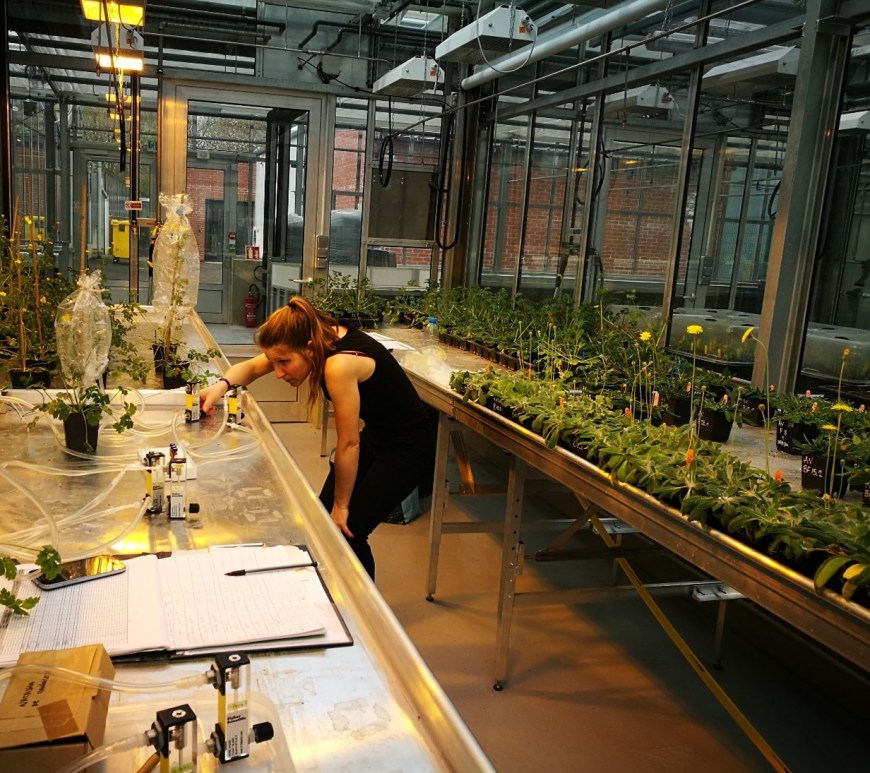
Natasha de Manincor checking the dynamic headspace material during floral scent extraction in the greenhouse (University of Lille, Plateforme Serre, cultures et terrains expérimentaux). (Photo credits: Leslie Faucher)

Natasha de Manincor: Geographical floral scent variation depends on pollinators and plant species identity

In this new post, Natasha de Manincor from University of Lille presents her work “Geographical variation of floral scents in generalist entomophilous species with variable pollinator communities”. She highlights the importance of Volatile Organic Compounds for pollination, discusses the mechanisms behind plant intraspecific chemicals variability and shares her passion for fieldwork all over the world. About the paper Plants are limited by their immobility, so … Continue reading Natasha de Manincor: Geographical floral scent variation depends on pollinators and plant species identity