Nick Gulotta | To stay or to roam? Behavioural type influences trade-offs in male wild turkey survival

In this ‘Behind the Paper’ blog post, author Nick Gulotta – a postdoctoral researcher at the University of Georgia, USA – helps us get “familiar” with turkey behaviour! Discussing the article “To stay or to roam? Behavioural type influences trade-offs in male wild turkey survival“, Nick delves into how the benefits of familiarity for turkeys depend on the threats they face, the process of tagging … Continue reading Nick Gulotta | To stay or to roam? Behavioural type influences trade-offs in male wild turkey survival

Grace Hirzel | Up to their eyes: seasonal changes in vision, behaviour, and wing colour in a temperate butterfly

In this week’s blog post, we’re gearing up for a shift in seasons with author Grace Hirzel as we explore the behavioural changes in a temperate butterfly. Based on their paper: “Synchronous seasonal plasticity in colouration, behaviour, and visual gene expression in a wild butterfly population”, Grace shares with us how seasonal conditions impact behaviour and how animals perceive their environment. Through the use of … Continue reading Grace Hirzel | Up to their eyes: seasonal changes in vision, behaviour, and wing colour in a temperate butterfly

Anina Coetzee | Colourful defenses against bees

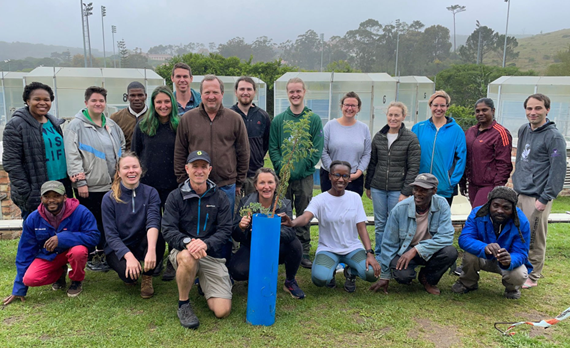
In this ‘Behind the Paper’ blog post, author Anina Coetzee – a lecturer at Nelson Mandela University, George campus, South Africa – shares the ‘buzz’ about bee avoidance in bird-pollinated flowers! Discussing the research article ‘Is bee-avoidance by bird-pollinated flowers driven by nectar robbing in Erica?‘, Anina delves into the bee-avoidance hypothesis, the beauty of Erica as a study species, and where sci-fi books and … Continue reading Anina Coetzee | Colourful defenses against bees

Pooja Radhakrishnan | Game over: Conflict resolution through strategic growth in an invertebrate

In this week’s blog post, we’re climbing the ranks to understand strategic growth in invertebrates! Discussing their paper: “Game over: Conflict resolution through strategic growth in an invertebrate”, author Pooja Radhakrishnan reveals how a marine annelid worm establishes a size hierarchy to compete against individuals they interact with. Pooja helps us understand how social competition can drive the evolution of adaptive mechanisms such as strategic … Continue reading Pooja Radhakrishnan | Game over: Conflict resolution through strategic growth in an invertebrate

Soumen Mallick | No one-size-fits-all forest management: what elevation reveals about herbivory and plant stress 

In this ‘Behind the Paper’ blog post, author Soumen Mallick – a Postdoctoral researcher at Field Station Fabrikschleichach, University of Würzburg – discusses the paper “Elevation reverses the effects of forest structure on folivory and leaf asymmetry“, which was recently published in Functional Ecology. Soumen shares how the team conducted large-scale forest experiments across Germany, the influence of climate on the impacts forest management actions, and the importance … Continue reading Soumen Mallick | No one-size-fits-all forest management: what elevation reveals about herbivory and plant stress 

Manuel López-Aliste | Differential effects of agricultural expansion on wild bee taxonomic and functional diversity

In this ‘Behind the Paper’ blog post, author Manuel López-Aliste discusses the paper “Differential effects of agricultural expansion on wild bee taxonomic and functional diversity“, which was recently published in Functional Ecology. Manuel discusses how agricultural expansion affects the variety of bee traits, using an entomological collection to measure functional traits, and the importance of trusting the process. About the paper Our paper focuses on … Continue reading Manuel López-Aliste | Differential effects of agricultural expansion on wild bee taxonomic and functional diversity

Haldane Prize 2025 | Marion Boisseaux: Shifting trait coordination along a soil-moisture-nutrient gradient in tropical forests

2025 HALDANE PRIZE SHORTLIST: Marion Boisseaux, discusses her paper ‘Shifting trait coordination along a soil-moisture-nutrient gradient in tropical forests’, which has been shortlisted for Functional Ecology’s 2025 Haldane Prize for Early Career Researchers. About the paper Within the framework of the niche theory, the environment acts as a filter, and selects for species in a local community. The concept of environmental filtering explains that not … Continue reading Haldane Prize 2025 | Marion Boisseaux: Shifting trait coordination along a soil-moisture-nutrient gradient in tropical forests

Joanna Sudyka | Why do birds cheat?

In this week’s blog post, we find out how relationship woes are abundant in the bird community! Through her paper: “Avian extra-pair paternity in the last European primeval forest”, author Joanna Sudyka provides an explanation for the question: “why do birds cheat?”. Joanna explains the mating and parental behaviour in blue and great tits, building on decades of research in Poland’s Białowieża National Park. Joanna and team found that different paternal DNA in nestlings is the result of an evolutionary behaviour that can persist in both wilderness and … Continue reading Joanna Sudyka | Why do birds cheat?

Rosemary Glos | Trapped, Poked, and Poisoned: Evidence for Defence Synergisms in a Desert Plant 

In this ‘Behind the Paper’ blog post, Rosemary Glos (she/her, University of Michigan, Ann Arbor, Mi, USA) discusses her research article ‘Separate and Synergistic Anti-Herbivore Effects of Non-Glandular Trichomes and Leaf Chemistry in a Desert Plant‘, which was recently published in Functional Ecology. Rosemary discusses synergistic interactions between plant defence traits, the utility of a beard-trimmer in the field, and the joys of roller derby! … Continue reading Rosemary Glos | Trapped, Poked, and Poisoned: Evidence for Defence Synergisms in a Desert Plant 

Dusanka Vujanovic | Landscapes that choose their butterflies

In this week’s ‘Behind the Paper’ blog post, author Dusanka Vujanovic discusses their new research article “Larval diet breadth and wingspan mediate landscape–richness relationship in butterfly communities“. Dusanka, a Research Associate at BioSense Institute, Serbia, examines what best explains variation in butterfly species richness across semi-natural grasslands: landscape structure, community trait composition, or their interaction. Dusanka focuses on whether landscapes shape not only how many … Continue reading Dusanka Vujanovic | Landscapes that choose their butterflies