Bálint Üveges

Bálint Üveges: Toad poison is a Swiss army knife against multiple enemies

In this post Bàlint Uvëges, postdoc at Bangor University, present his latest work ‘Chemical defence effective against multiple enemies: Does the response to conspecifics alleviate the response to predators?’, discuss the multiple ways animals have to avoid predation and shares his passion for venomous creatures. Ez a blog magyarul is elérhető itt! About the paper Predation is commonplace in nature, so prey animals need to … Continue reading Bálint Üveges: Toad poison is a Swiss army knife against multiple enemies

Margaux Didion-Gency at the Lago di Nambino, Italy.

Margaux Didion-Gency: Interactive effects of tree species mixture and climate on foliar and woody trait variation in a widely distributed deciduous tree.

Margaux Didion-Gency, Ph.D. at the Swiss Federal Institute for Forest, Snow and Landscape Research (WSL) of Birmensdorf (Switzerland), presents her first published paper and discusses the importance of tree species interactions in the context of climate change. About the paper This study was motivated by previous research that reported the positive effect of species richness on grassland resistance to extreme events. However, we noticed that … Continue reading Margaux Didion-Gency: Interactive effects of tree species mixture and climate on foliar and woody trait variation in a widely distributed deciduous tree.

Dustin Marshall: Mother-offspring conflicts: Temperature can change selection on offspring size

Professor Dustin Marshall, Australian Research Council Fellow and the Head of the Marine Evolutionary Ecology Research Group / Centre for Geometric Biology at Monash University, discusses with us his recently accepted paper “Temperature-mediated variation in selection on offspring size: a multi-cohort field study.” What is the background to your paper? We know offspring size varies enormously and understanding this variation is a long-standing goal of … Continue reading Dustin Marshall: Mother-offspring conflicts: Temperature can change selection on offspring size

Libor Zàvorka with a male adult Atlantic salmon during milt and eggs collection.

Libor Zàvorka: warming shrinks juvenile Atlantic salmon by decreasing their fatty acids

In this blog, postdoc Libor Zàvorka from Inter-University Centre for Aquatic Ecosystem Research (Lunz) discuss his research on climate change effects on salmon diet, shows the relevance of physiological changes in ecosystems and presents his long record as fish catcher.  About the paper The big question: how does variability in content of essential fatty acids in natural prey drive development and evolution of brain and … Continue reading Libor Zàvorka: warming shrinks juvenile Atlantic salmon by decreasing their fatty acids

Natalie Oram: how prepared are legumes for climate change?

In our latest post, Natalie Oram recalls her work at the Wageningen University ‘Plant traits of grass and legume species for flood resilience and N2O mitigation’, highlights the importance of diverse plant strategies to cope with flood and suggests there is a limit for how much ABBA a person can listen to. It’s raining, it’s pouring Climate change is increasing the frequency and severity of … Continue reading Natalie Oram: how prepared are legumes for climate change?

Ellen Chenoweth uses a prey mapping robot to measure the distribution of hatchery salmon after a release at Hidden Falls Hatchery in Alaska.

Ellen Chenoweth: salmon hatcheries are not the best buffet for Baleen whales

In our latest post, Ellen Chenoweth from University of Alaska Fairbanks introduces her work ‘Confronting assumptions about prey selection by lunge-feeding whales using a process-based model’, discusses how the apparently easiest foraging strategy is not always the optimal and presents the diverse set of project she and her colleagues are currently running. About the Research Baleen whales are generalist and innovative predators. They grow to … Continue reading Ellen Chenoweth: salmon hatcheries are not the best buffet for Baleen whales

Curtis Lubbe

Curtis Lubbe: Right place, wrong time? Hide in the soil – avoidant strategies in plants

In this new post, Curtis Lubbe from the Institute of Botany (Czech Academy of Sciences) presents his latest work ‘Winter belowground: changing winters and the perennating organs of herbaceous plants’, discuss the importance of plant storage organs in perennial plants and surprise us with his drawing talent. About the paper This paper is a review of our current understanding of how the belowground storage organs … Continue reading Curtis Lubbe: Right place, wrong time? Hide in the soil – avoidant strategies in plants

Daniel Kenna

Daniel Kenna: Warming air temperature drives changes in bumblebee flight performance

In this post, Daniel Kenna from Imperial College London’s Silwood Park Campus, explores how bumblebee flight responds to temperature change, discusses what this implies about the effects of climate change on our pollinators, and recounts his experiences in the lab. About the paper Bees’ flight performance affects their ability to pollinate plants, which is a crucial service for many of our crops and garden plants. … Continue reading Daniel Kenna: Warming air temperature drives changes in bumblebee flight performance

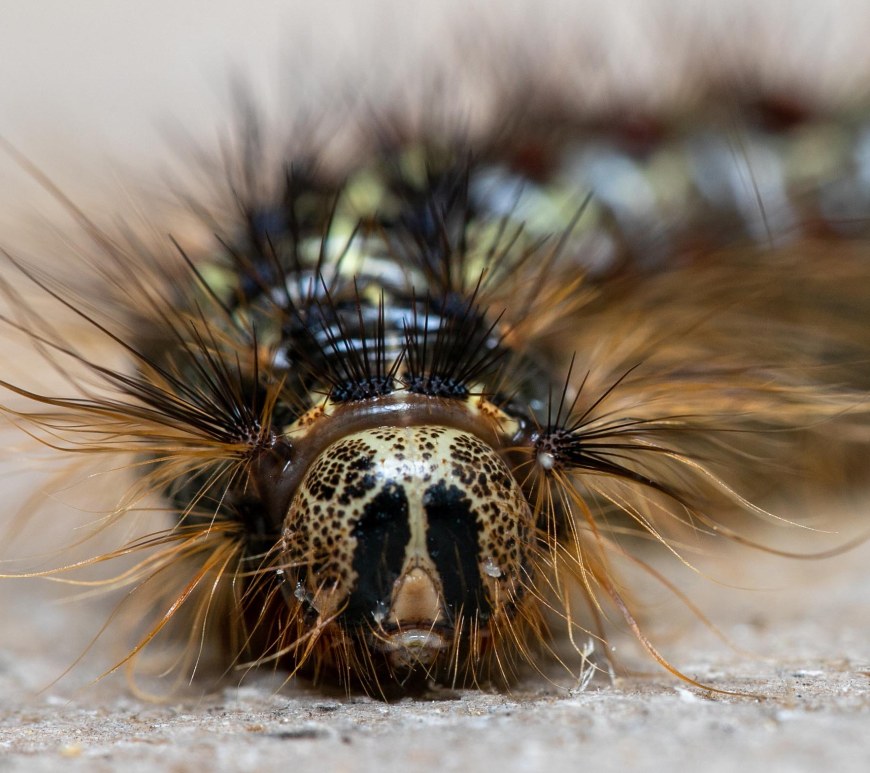
Lymantria dispar (caterpillar shown here) is one of the most destructive invasive insects in North America. Defoliation by this insect can kill oak trees by draining the trees’ energy reserves. Photo credit: Nathan Oalican.

Audrey Barker Plotkin: Trees can starve to death from insect defoliation

In this post, Audrey Barker Plotkin of Harvard University talks to us about her latest research where she investigates how invasive insects can starve trees and the importance of protecting temperate forest land. Este blog también está disponible en español I’m a forest ecologist based at the Harvard Forest in the northeastern United States. Because of high levels of global trade and forest cover, our … Continue reading Audrey Barker Plotkin: Trees can starve to death from insect defoliation

Sam van Wassenbergh at the computer at University of Antwerp, Department of Biology.

Sam van Wassenbergh: aerodynamics behind lizards resistance to hurricanes

In our latest post, Sam van Wassenbergh from the University of Antwerp discusses his latest work ‘An aerodynamic perspective on hurricane-induced selection on Anolis lizards’. He presents the importance of functional traits trade-offs in species adaptations, highlights the need to use multidisciplinary approaches in science and shares his pride on working with his student. About the paper In our paper, we wanted to understand why … Continue reading Sam van Wassenbergh: aerodynamics behind lizards resistance to hurricanes