Carolina Olguín Jacobson on when the ocean heats up: what 15 years of community-led monitoring revealed about marine protected areas in kelp forest

In this week’s blog post we’re discussing tackling climate change through 15 years of community-led exploration of underwater kelp forests. Carolina Olguín Jacobson, author of “Recovery mode: Marine protected areas enhance resilience of invertebrate species from marine heatwaves”, shares insight into the effects of heatwaves on kelp-related species and how monitoring and conservation efforts like Sirenas de Natividad and the Marine Protected Areas (MPAs) of … Continue reading Carolina Olguín Jacobson on when the ocean heats up: what 15 years of community-led monitoring revealed about marine protected areas in kelp forest

Théo Bodineau: The impact of nocturnal warming and prey availability during reproduction in a viviparous lizard

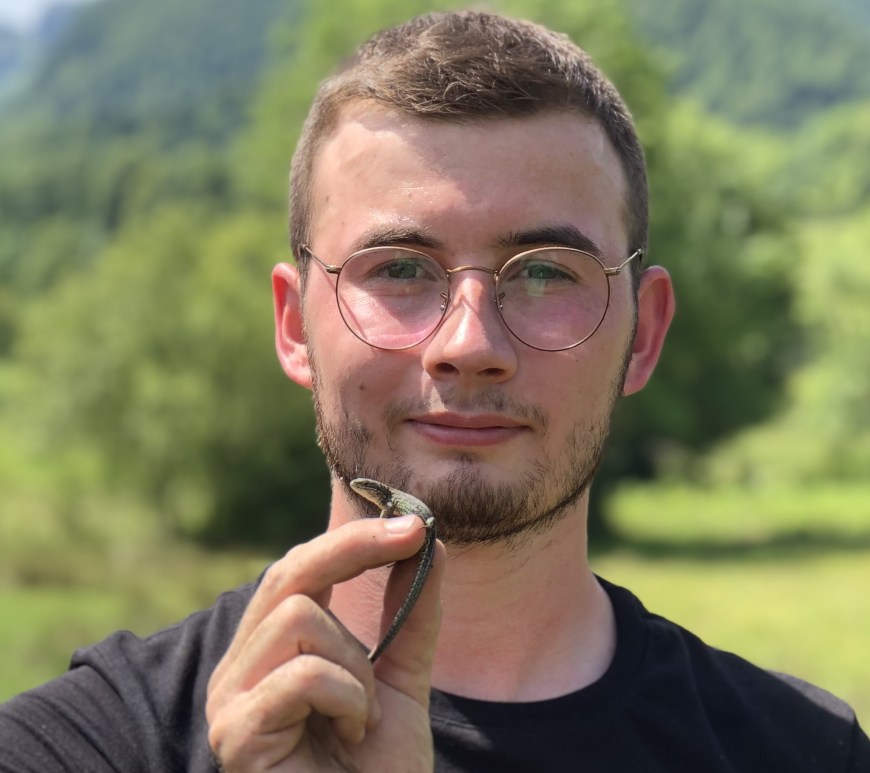
In this week’s blog post, we’re checking our calendars and addressing how climate change is causing shifts in breeding dates for reptiles! Discussing the article “A multi-trait evaluation of patterns and fitness consequences of breeding phenology plasticity with nocturnal warming and food restriction in a lizard”, Théo Bodineau explains just how sensitive the natural world can be to thermal changes from climate change and how … Continue reading Théo Bodineau: The impact of nocturnal warming and prey availability during reproduction in a viviparous lizard

Jennifer Apland: does flower temperature affect pollinator behaviour?

In this week’s blog post, we learn what’s the buzz about pollinators and their affinity to heat. Through her recently published paper: “Isolating the effects of floral temperature on visitation and behavior of wild bee and fly pollinators”, Jennifer explores how traits and behaviours of insect pollinators can shift according to varying flower temperatures under different environmental conditions. This work is crucial to help us … Continue reading Jennifer Apland: does flower temperature affect pollinator behaviour?

Caroline Isaksson: Combined light & traffic noise exposure enhances songbirds’ antioxidant capacity & lowers damage

In our latest post, author Caroline Isaksson explores the impacts of urban pollutants on songbirds! In their recent paper: “Effects of short-term multi-pollutant exposure on the oxidative stress status of captive songbirds”, Caroline investigates how three urban pollutants impacts Zebra finches physiologically. Caroline also shares the surprising results that will promote deeper research into this dynamic. Amid her experiments, Caroline imparts advice we all need … Continue reading Caroline Isaksson: Combined light & traffic noise exposure enhances songbirds’ antioxidant capacity & lowers damage

Rainbow Research: Contribute to our Pride Month Blog Series!

To celebrate Pride Month in June, we are relaunching our Rainbow Research blog series! This series aims to promote the visibility and inclusion of ecologists and evolutionary biologists from the LGBTQIA+ community. Each post will be connected to a theme represented by one of the colours shown in the Progress Pride Flag:  Posts can link to any of these themes, whether it connects to your … Continue reading Rainbow Research: Contribute to our Pride Month Blog Series!

Tim Forrester: Weight loss in female birds – an adaptive strategy

In this blog post, Tim Forrester helps answer a weighty question: Does weight loss help or hurt nesting birds? Based on his recent paper with Tom Martin, “Observational and experimental evidence that rapid mass loss is consistent with the flight efficiency hypothesis and not caused by reproductive effort in three passerine bird species”, Tim shares the fascinating physiological adaptations undergone by songbirds in anticipation of … Continue reading Tim Forrester: Weight loss in female birds – an adaptive strategy

Junghyuk Keum: Smart bird catches the worm

In this week’s blog post, we delve into the intelligent mechanisms behind how and why the smart bird catches the worm! Author Junghyuk Keum gives us a glimpse into the Cognitive Buffer Hypothesis – a theory they used to explore seabird ecology in their recently published paper: “Does brain size matter? Linking cognitive and ecological traits to climate change vulnerability in seabirds.” Junghyuk expands on … Continue reading Junghyuk Keum: Smart bird catches the worm

Congratulations to Yuguo Yang, winner of the 2024 Haldane Prize!

Functional Ecology is delighted to announce that the winner of the 2024 Haldane Prize is Yuguo Yang! The Haldane Prize is awarded annually for the best paper published in the journal by an early career researcher. Winner: Yuguo Yang Research: Trade-offs in rooting strategy dimensions along an edaphic gradient in a grassland ecosystem Yuguo is a postdoctoral scholar at Lawrence Berkeley National Laboratory working with Dr. Romy … Continue reading Congratulations to Yuguo Yang, winner of the 2024 Haldane Prize!

Angela Illuminati: A closer look to roots in drylands

In this new post Angela Illuminati, postdoc at University Rey Juan Carlos, Spain, presents her work ‘Functional differences between herbs and woody species in a semiarid Mediterranean plant community: a whole-plant perspective on growth, nutrient-use and size’. She talks about the many gaps existing in dryland plant ecology, shows the amazing distances that roots systems cover, and shares how science strengthens her family bonds.  About … Continue reading Angela Illuminati: A closer look to roots in drylands

Stephanie Chia: Mechanistic understanding of how temperature and its variability shape body size composition in moth assemblages

2024 HALDANE PRIZE SHORTLIST: Stephanie Chia discusses her paper “Mechanistic understanding of how temperature and its variability shape body size composition in moth assemblages“, which has been shortlisted for Functional Ecology’s 2024 Haldane Prize for Early Career Researchers: About the paper Have you ever watched a diverse array of moths gather around a glowing light in the mountains at night? And if you head up … Continue reading Stephanie Chia: Mechanistic understanding of how temperature and its variability shape body size composition in moth assemblages