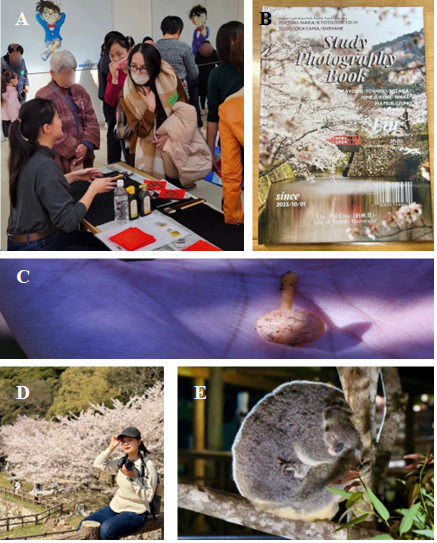
In this blog post, we hear from the second-place winner of Functional Ecology’s presentation prize at the International Conference on Mycorrhiza (ICOM), Liu. Pei-Chu! Liu. Pei-Chu shares her presentation “Effects of different carbon sources on symbiotic conditions and pH during artificial infection”. She discusses how different bacterial strains affect mycelial growth and interact with fungus, her first time at a large international conference, and her top tips for other attending theirs!
About the presentation
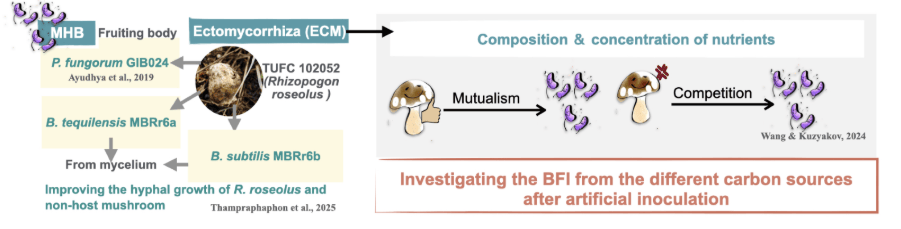
My research focuses on how different bacterial strains affect the mycelial growth of Rhizopogon roseolus and how these bacteria interact with fungus. Previous researches isolated Paraburkholderia fungorum GIB024 (G-) from the fruiting bodies of R. roseolus, and Bacillus tequilensis MBRr6a and Bacillus subtilis MBRr6b (G+) from the its mycelia. Although these bacterial strains differ in their characteristics, they have all shown the ability or potential to promote the mycelial growth of this ectomycorrhizal fungus. Furthermore, previous studies found that reducing glucose or using malonate as a carbon source affected the symbiotic performance of the G- bacterium. These findings suggest that carbon source availability may influence BFI. These observations raise several questions: how does carbon source availability affect the interactions between R. roseolus and its associated bacteria? How do the fungus and bacteria respond to different carbon source, and how might these influence their coexistence? Therefore, this study aims to compare the responses of R. roseolus mycelia and three bacterial strains under glucose and malonic acid conditions, in order to investigate how carbon sources influence BFI (Fig 1).
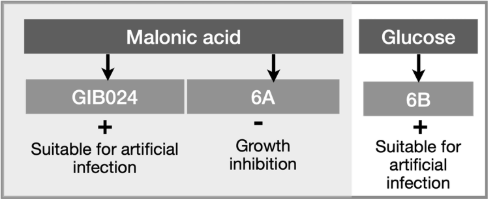
There are two main findings in this study. (1) Malonic acid was less favorable than glucose under tested conditions. When R. roseolus was co-cultured with bacteria in glucose-containing medium, greater medium acidification and vigorous bacterial proliferation were observed than in malonic acid-containing medium. These findings suggested that glucose was more readily utilized greater microbial activity under the tested conditions. In contrast, malonic acid- containing medium was associated with reduced medium acidification, bacterial activity, and mycelial growth. (2) The bacterial strains exhibited distinct functional characteristics. 6A inhibited mycelial growth under both carbon-source conditions, especially under malonic acid-containing medium. In contrast, 6B exhibited greater activity in glucose-containing medium. Meanwhile, GIB024 exhibited relatively stable activity under both carbon-sources conditions (Fig 2).
These findings may provide foundation for further research on co-cultivation and artificial infection. However, the persistence of bacteria in mycelia following artificial inoculation, and promoting ability of mycorrhiza formation deserve further investigation. In addition, how the bacterial characteristics influence fungal development, symbiotic performance, and the efficiency of bacterial inoculation remains an important direction for future research.
During this research, I found that characteristics such as odor and mycelial color can be affected by symbiotic bacteria. However, there do not seem to be many studies providing information on these aspects. In addition, I personally believe that developing a comprehensive set of indicators for symbiosis would be worth exploring, as it could help researchers working on symbiosis in the future. For example, changes in pigmentation or odor detection using instruments such as gas chromatography (GC) could be used as indicators of symbiosis, allowing researchers to conduct preliminary assessments using such a system. Of course, with big data and artificial intelligence becoming increasingly widespread, collecting data and using it to develop an AI-based system is another possible direction. Regardless of the approach, I hope this research will be helpful to other researchers working on symbiosis.
About the conference
This trip to Australia was my first long-haul flight outside Asia. The journey took seven and a half hours. For people who are accustomed to long-haul flights, that might not seem very long. However, as it was my first time taking such a flight, I found myself repeatedly waking up and falling asleep in a not particularly comfortable economy-class seat. Although I was exhausted, on the very day I arrived, I boarded a cruise heading toward the Great Barrier Reef. Seeing the crystal-clear ocean, clean beaches, and rich biodiversity was an unforgettable experience. Looking back, it is truly a wonderful memory.
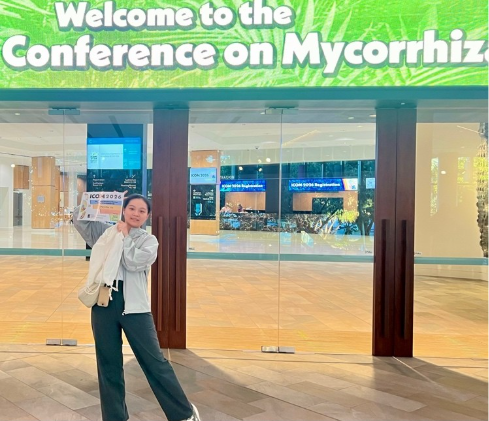
In addition to taking my first long-haul flight, this was also my first time attending such a large international conference. Before this, I had participated in conferences of various sizes in both Japan and Taiwan, but ICOM16 has been the most memorable one for me so far, and even surprisingly awarded from British Ecological Society Journal (Fig 3). Before starting my research on mycorrhizal fungi, my work mainly focused on the functional properties of mushrooms and food science. Therefore, my understanding of mycorrhizal fungi and ecology was not as extensive as that of colleagues who had been working in this field for a long time. ICOM16 provided me with an excellent opportunity to engage in in-depth discussions with researchers in the mycorrhizal community.
During the conference, I listened to many interesting presentations, such as Dr. Matthew Smith’s presentation on the relationships between birds (Scelorchilus rubecula and Pteroptochos tarnii) or small mammals (such as foxes) and truffles. I also gained more ideas about symbiotic relationships, including the tripartite symbiosis among arbuscular mycorrhizal (AM) fungi, ectomycorrhizal (ECM) fungi, and trees. Everyone in this community was very approachable. I felt free to talk with people and exchange ideas, which also gave me a stronger sense of belonging to this field. I hope that one day I can go further in the study of microbial symbiosis and share my research with everyone at ICOM with the same confidence and composure as the experienced researchers I met.
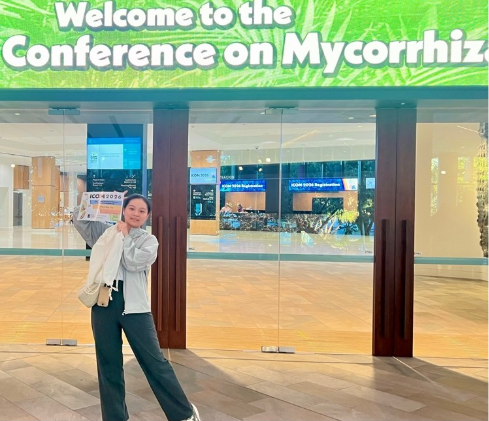
Advice for first-time conference attenders
(1) Take the initiative to talk with experienced researchers and fellow researchers during poster sessions.
Talk to people whose research interests you. You may find that they are very welcoming toward early-career researchers and are open to answering questions. They may even offer you warm encouragement and thoughtful responses.
(2) Participate in the lightning talk session whenever possible.
Even if you are presenting a poster, how can more people learn about your research and be encouraged to visit your poster if you do not give a presentation on stage? So, give it a try and become the best advocate for your own research!
(3) Put your business cards at your poster and keep your contact information up to date.
I think exchanging business cards is a familiar practice in many parts of Asia. If you expect to interact with researchers from Asia, preparing business cards can be useful. For researchers from other regions, make sure your LinkedIn profile and other contact information are up to date! This will make it easier for everyone to stay in touch and continue exchanging ideas after the conference.
(4) Whatever you think of your research or language skills, make the most of this academic feast.
If you have overcome all the challenges involved in securing funding, producing research results, and applying to attend the conference, take a moment to give yourself credit. Enjoy the opportunity to interact with people from all over the world! You may discover that other researchers also experience moments of self-doubt or regret. Nevertheless, the outcomes of these experiences can be incredibly rewarding and fascinating. So, enjoy the conference and make the most of every opportunity to learn from others!