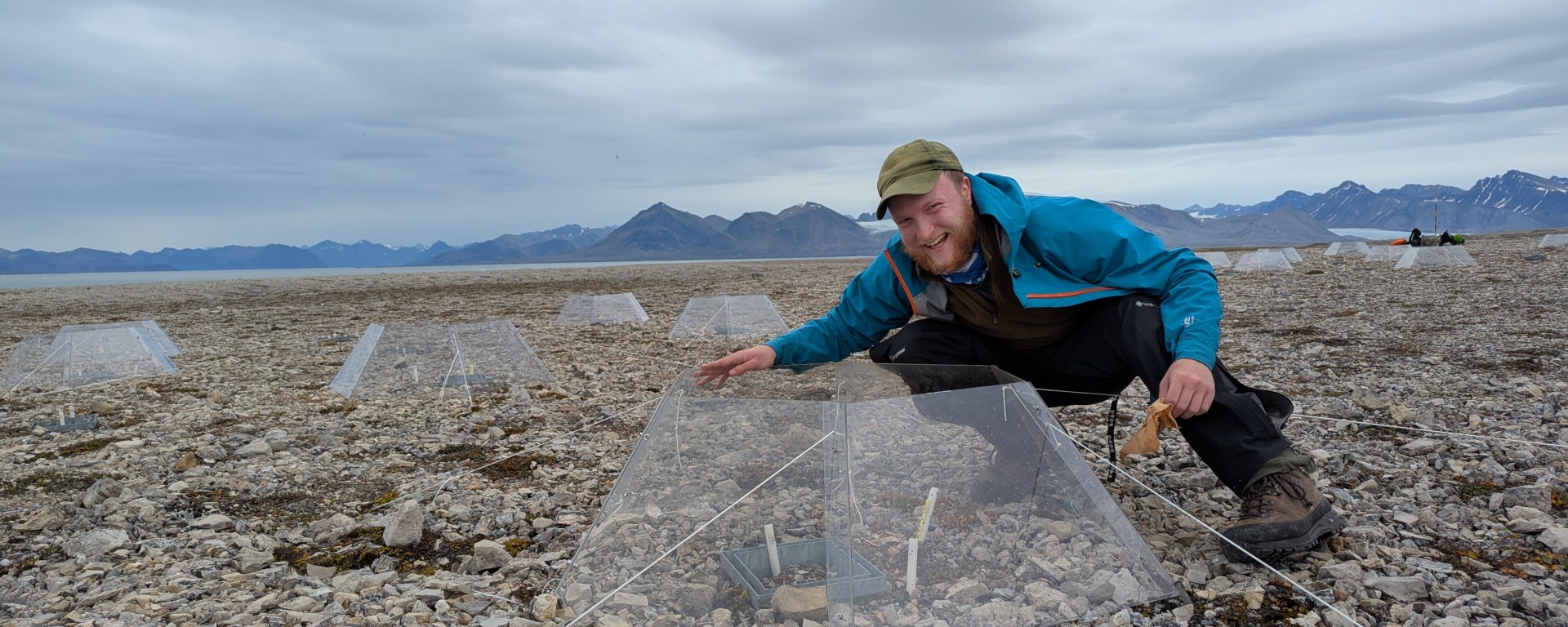
In this ‘Behind the Paper’ blog post, we’re taking a trip to Svalbard with author Jiří Šubrt to investigate lichen bleaching! Jiří – a PhD student at the University of Edinburgh – shares insights into the paper ‘Lichen bleaching as a response to long-term experimental warming in the High Arctic‘, which was recently published in Functional Ecology. Jiří discusses lichen bleaching on Svalbard as a warning sign around the world, conducting fieldwork on crutches, and the joy of learning languages.
About the paper
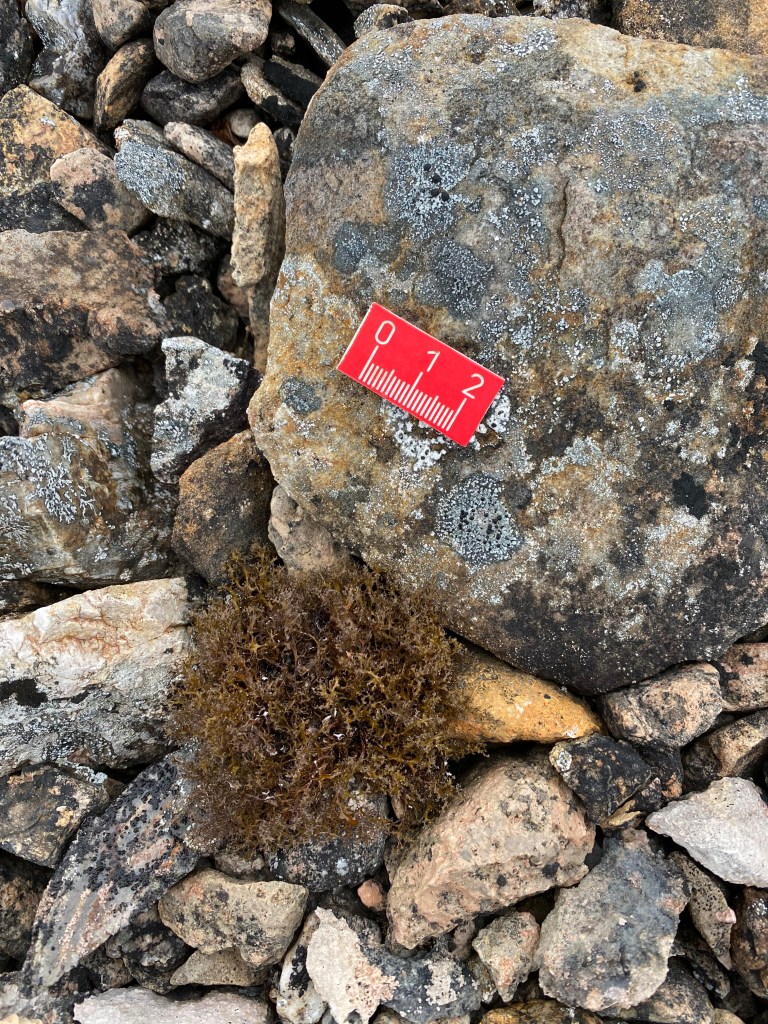
Our paper investigates the impact of climate warming on lichens, symbiotic organisms composed of two main partners, a photobiont, alga or cyanobacteria, and mycobiont, a fungus. We investigated how a long-term experimental warming affected lichen physiology on Svalbard, in the High Arctic, where lichens are one of the dominant life forms living there. The warming chambers experiment was established in 2014, and we collected samples of an important High Arctic lichen, Cetrariella delisei, after nine years of continuous exposure to warming. We wanted to know whether lichens exposed to warmer conditions would acclimate their physiological traits or deteriorate.
We found that instead of acclimating to warmer conditions, they deteriorated. Together, samples exposed to warmer conditions bleached, and this shows many similarities to coral bleaching process. Therefore, corals might not be the only symbiotic organisms experiencing a so-called “dysbiosis”, a breaking of the intricate symbiotic relationship between an autotroph and a heterotroph. The archipelago of Svalbard, for example, is warming at up to seven times more than other places. This means that if lichens start to bleach, we are most likely to notice it here first. If we can detect bleaching here, we can use that information as an early warning sign for lichens in other places around the world. If lichens on Svalbard (and elsewhere!) cannot collectively acclimate to warming, it could have an impact on herbivore diets and other ecosystem services they provide.
About the research
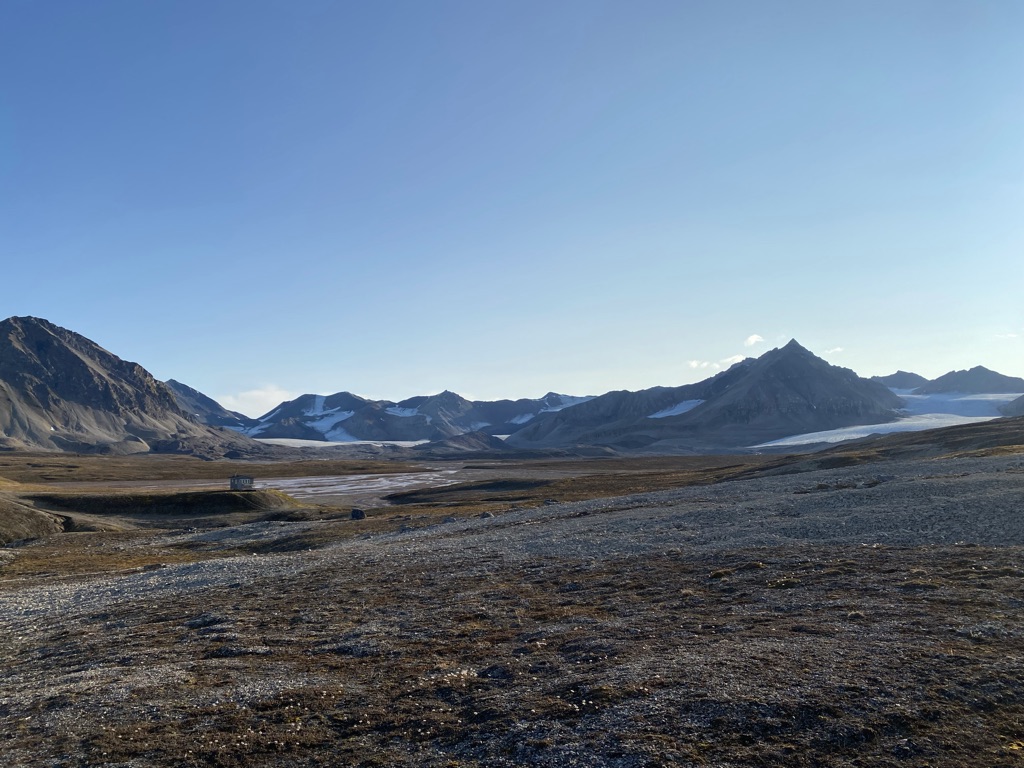
We collected samples on Svalbard and then transported them to our lab in Edinburgh to characterize physiological responses. Specifically, we measured photosynthesis and respiration under different light and temperature conditions, as well as chlorophyll and algal content. Seeing the High Arctic for the first time was definitely a highlight of this project. Working up north requires a lot of careful planning and safety considerations because of the harsh conditions and wildlife, but luckily, everything went well, apart from one unexpected event. A week before my deployment on Svalbard, I broke my ankle while canyoning in the Alps. However, I wasn’t about to let that stop me! To get to our site, I had to walk through the rocky tundra. This was one of the biggest challenges I have ever done, as I had to do everything with two crutches. I will probably never forget the looks from other people on the station when I appeared limping with crutches! I would like to thank the whole team for their help, as this is always a big team effort.
The results of the paper were quite surprising, because in my head, these organisms are super resilient to stresses that not many other organisms could withstand. When lichens are dry, hence “hibernating” until their next hydration event, you can send them to space, expose them to really hot and cold temperatures, light, or prolonged darkness. They will withstand this. However, when they are brought back to life and experience harsh conditions while active, this is when it gets tricky for them. Being active in warmer, not ideal conditions, was most likely the reason for this bleaching response. The next step for this research topic is to look into lichen bleaching more, seeing if this is a species-specific or more widespread phenomenon, and studying thermal acclimation of Arctic lichens more in depth.
About the author
I remember writing a motivation letter for my undergraduate programme in Ecological and Environmental Science at the University of Edinburgh, and most of that letter was about my love for oceans through scuba diving and the fact that I loved corals! Little did I know that one day I would dive into the world of a terrestrial symbiotic organism, lichen. After that, I spent almost three months in the field in the Canadian tundra as a research assistant surrounded by other PhD students. I knew I wanted to do a Research Master programme, to see if research was something I could imagine dedicating myself for a full PhD. Claudia Colesie, the mastermind behind this work, talked to me about a possible project, and she had some lichen samples from Svalbard and asked whether I would like to study them and go to the High Arctic myself. This was both the start of the project, and a passion as well. We often joke about that once you get introduced into the world of lichens, you can never leave! Now, for my PhD, I continue studying lichens in extreme environments, lichen bleaching, and acclimation of this intricate organism to climate change.
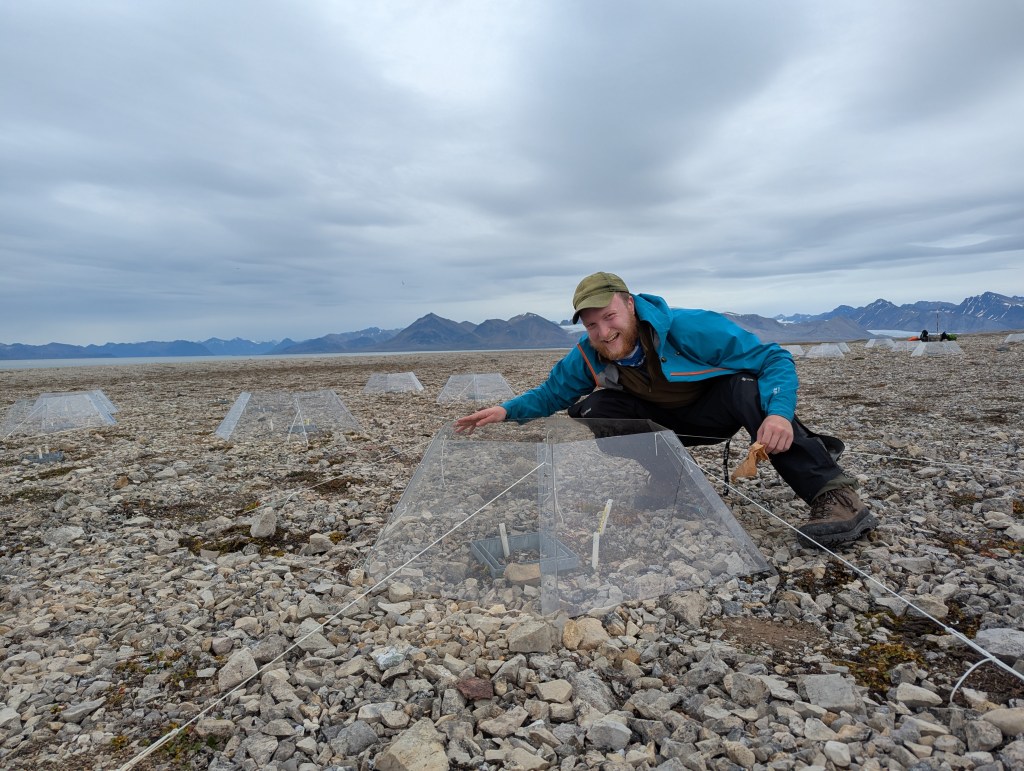
Outside of research, my lifelong obsession is languages. If I didn’t dedicate to ecology, I would have most probably gone to study linguistics. However, I found a way how to integrate that into my research, that is why I love international collaborations where speaking a local language helps break down the barriers and understand each other better. Not being a native English speaker seemed restrictive at the beginning of my career, but now I see it as something that keeps opening doors rather than closing them. If I could give some advice to my younger self in academia, it would be to not compare yourself to other people, and that through dedication, good things arise. Basically, don’t worry and overthink things too much!
 Functional Ecologists