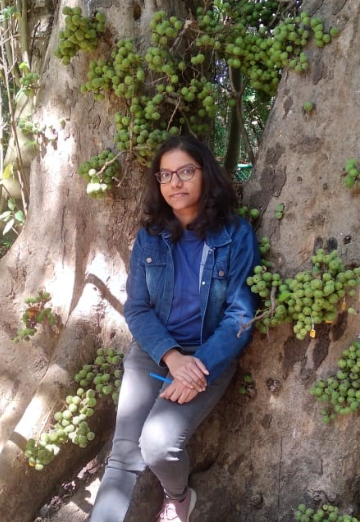
In this ‘Behind the Paper’ blog post, author Manasa Kulkarni, discusses the paper ‘Developing together: the elementome and biogeochemical niche of the mutualistic occupants of a fig microcosm’, which was recently published in Functional Ecology! Manasa delves into the fascinating world of mutualisms, protecting study fig trees from pests, and the role that field work plays in inspiring new research.
About the paper
When any two species interact with each other and benefit from the interaction, the phenomenon is called a mutualism. Just as in a human market, partners in a mutualism exchange services for resource rewards. Since elements form the basic building blocks of all organisms and the resources they consume, what would trading in a mutualism look like at the elemental level?
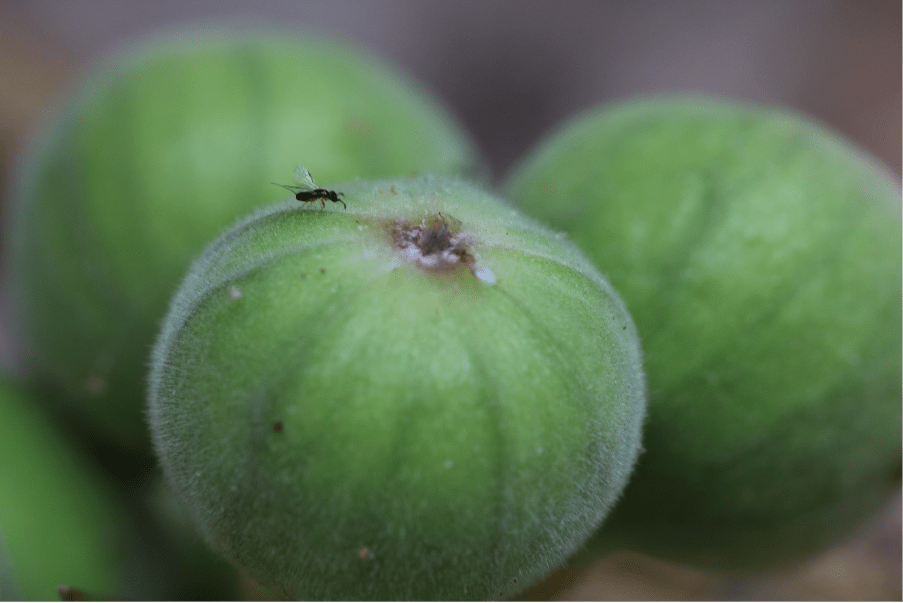
In our paper we try to address this question in a fascinating mutualism between fig trees and their pollinator wasps. Flowers of fig trees, arranged in enclosed inflorescences called fig syconia, are pollinated by tiny, species-specific pollinator fig wasps. In exchange for this service, pollinators can lay their eggs in some flowers and their developing offspring receive nutrition rewards from the host. Our study attempts to understand this nutrient allocation at the elemental level. It began as a follow-up to our previous research [Kulkarni, Naik and Borges 2024; Kulkarni, Vadaserry and Borges 2025] which showed that both the host and pollinators regulate how resources flow to a syconium. Here we asked, what does it mean for the host tree to support a pollinator gall compared to its own seeds, and how different are their resource requirements?
In ecology, elements such as carbon, nitrogen and phosphorus have received tremendous attention. However, in our paper we tried to account for as many important elements as possible by using what is called an elementome— the concentrations of all elements present in an organism. We determined concentrations of elements that pollinators and fig seeds need compared to what the host tree can provide. In order to make a clear comparison, we used a relatively new concept called the Biogeochemical Niche (BN) which represents the concentrations of many elements that are visualised as an area in 2D-space. We used another parameter called Trophic Stoichiometric Ratio (TSR), which is a measure of mismatch between the needs of consumers (here, pollinator wasps and seeds) and resources provided by the host plant.
Our results reveal that pollinators, fig seeds and the syconial wall have distinct BNs, meaning that their elemental compositions are very different. This has many implications for the system. First, it suggests reduced competition between seeds and pollinator offspring developing in a shared space. It also highlights how different it is for the host tree to support its seeds compared to a pollinator wasp. Pollinator wasps are costlier to support than seeds; they need higher concentrations of elements such as nitrogen, zinc, phosphorus and sodium. TSR values for these elements show that there is mismatch between what pollinators need and what the host tree can offer. These differences can limit pollinator numbers and ultimately dictate how the mutualism functions. For the first time, we demonstrate how the concepts of BN and TSR can be excellent tools to understand trading of resources in important inter-species interactions like mutualisms.
About the research
Fig trees are a fascinating species to work with. They are a keystone species and at any given time, there is a lot going on around a fig tree. In our research, collecting an adequate quantity of samples was the foremost challenge that we faced. Pollinator wasps, especially the males, are very tiny and we needed huge numbers to make up enough sample to quantify all the elements. Additionally, the fig syconia are inhabited by many non-pollinator wasp species. In two sets of samples that we used, we performed controlled pollination, by keeping the syconia bunches covered with cloth bags; when the syconia were in pollen-receptive phase, pollinators were placed near the opening of the syconium and observed till they entered inside.
While controlled pollination allows us to reduce any effect that can be caused by non-pollinators and get more pollinators required to make up our samples, it comes with its own challenges. The first was to find enough pollinator wasps for pollination when the syconia were in pollen-receptive phase, which is a short period of 2–3 days where pollinator wasps can enter a syconium for pollination. Pollinator wasps needed be collected from other trees which were releasing the developed wasps and matching the timings and finding pollinators at the right time was always a challenge.
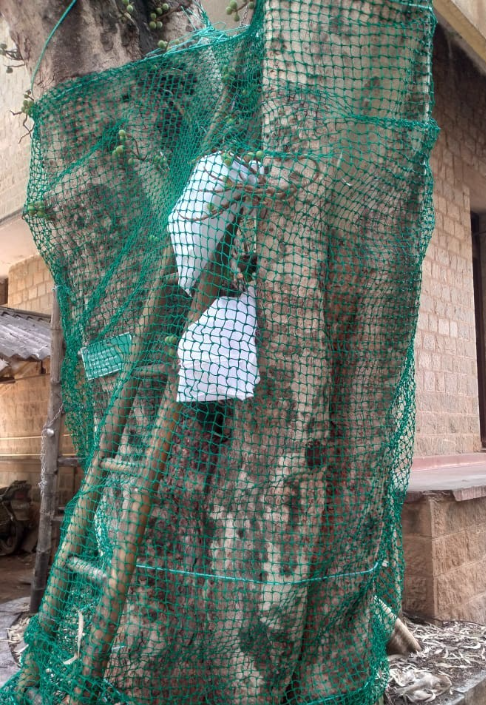
After pollination, the syconia were allowed to develop till the seeds and pollinator offspring completed maturation. During this time, the syconia faced many threats, such as ants trying to catch pollinators, fungus that grows on the syconia during the monsoon rains, squirrels that eat up nearly developed fig syconia, and the curious monkeys and sometimes even humans who open up the cloth bags around syconia bunches! Our experimental fig syconia needed to survive these threats in order to make up our samples.
About the author
I received my PhD from the Indian Institute of Science, Bengaluru, India, in 2025. My PhD thesis is on patterns and strategies of resource allocation in the mutualism between fig trees and their pollinator fig wasps. The current paper is a part of my PhD research. Since my days as an undergraduate studying zoology, microbiology and chemistry, I have been drawn to understand more about how nature functions, the patterns and mechanisms behind what we see around us. A Masters degree in Zoology in a university located close to a wildlife reserve only made this fascination stronger.
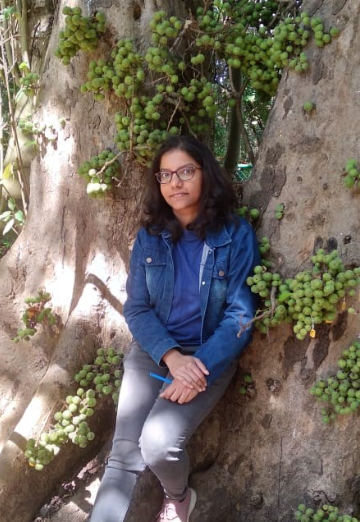
After my Masters, when I made up my mind to pursue a career ecology and evolution research, why and how organisms cooperate was one of the questions I wanted to address. My PhD supervisor, Prof. Renee M. Borges and her lab had done years of research on fig–fig wasp biology and this system was complex, interesting and very suitable to understand inter-species cooperation and I embarked upon it for my PhD thesis. Currently, I am working as research consultant, equivalent to a postdoc, in a collaborative project between the Indian Institute of Science and Ben Gurion University. In this work, I am concentrating more on the fig wasps and trying to understand egg-limitation in these wasps under different contexts.
I believe a research career in ecology has its own challenges, especially fieldwork. But these challenges broaden our horizons and finding solutions or successfully setting up experiments makes the effort very rewarding. Often field experiences lead to new questions that motivate us to keep exploring.

