Jahangir Vajedsamiei: Predicting key ectotherm population mortality in response to dynamic marine heatwaves


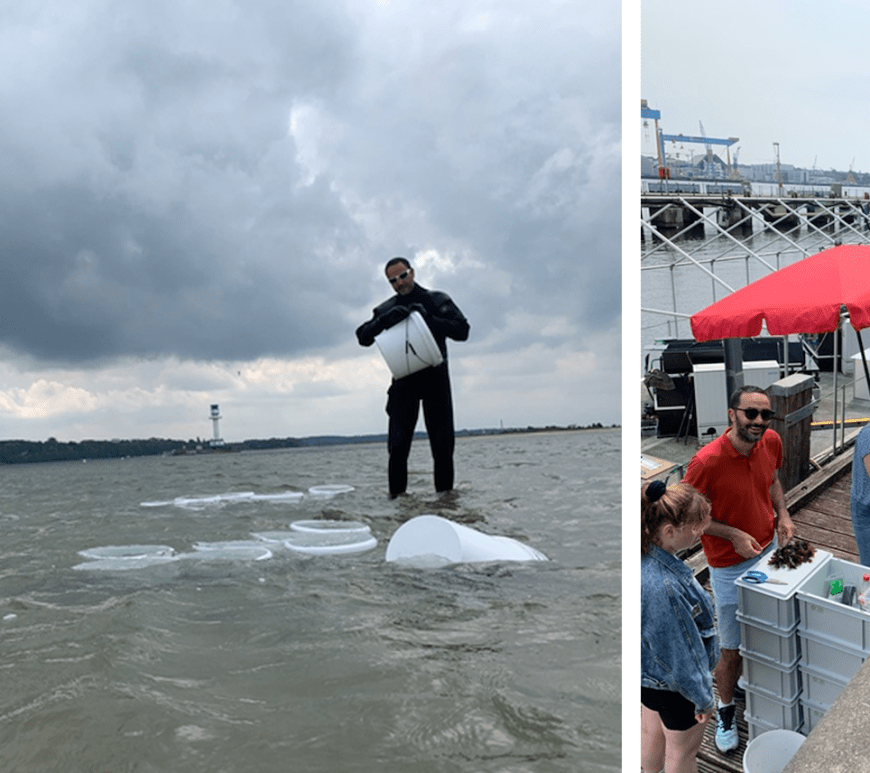
2024 HALDANE PRIZE SHORTLIST: Jahangir Vajedsamiei discusses his paper “Predicting key ectotherm population mortality in response to dynamic marine heatwaves: A Bayesian-enhanced thermal tolerance landscape approach“, which has been shortlisted for Functional Ecology’s 2024 Haldane Prize for Early Career Researchers: 👋 About the author I am honored to be nominated for the Haldane Prize for my recent work published in Functional Ecology. My journey as … Continue reading Jahangir Vajedsamiei: Predicting key ectotherm population mortality in response to dynamic marine heatwaves

Yuguo Yang: Trade-offs in rooting strategy dimensions along an edaphic gradient in a grassland ecosystem

2024 HALDANE PRIZE SHORTLIST: Yuguo Yang discusses his paper “Trade-offs in rooting strategy dimensions along an edaphic gradient in a grassland ecosystem“, which has been shortlisted for Functional Ecology’s 2024 Haldane Prize for Early Career Researchers: 🌱 About the paper Roots are essential to plant community function, serving as the gateway for interactions with the belowground world. Unlike leaves, which primarily absorb light and carbon … Continue reading Yuguo Yang: Trade-offs in rooting strategy dimensions along an edaphic gradient in a grassland ecosystem

Jihyun Kim: Heatwave-mediated decreases in phytoplankton quality negatively affect zooplankton productivity

2024 HALDANE PRIZE SHORTLIST: Jihyun Olivia Kim discusses her paper “Heatwave-mediated decreases in phytoplankton quality negatively affect zooplankton productivity“, which has been shortlisted for Functional Ecology’s 2024 Haldane Prize for Early Career Researchers: 👋 About the Author Broadly, my research interests lie in understanding how human impacts affect freshwater ecosystems. From a young age, I was fascinated by nature and was unwaveringly determined to study … Continue reading Jihyun Kim: Heatwave-mediated decreases in phytoplankton quality negatively affect zooplankton productivity

Julien Barrere: Diverse forests are more resilient to storm disturbances across Europe

2024 HALDANE PRIZE SHORTLIST: Julien Barrere discusses his paper “Forest storm resilience depends on the interplay between functional composition and climate—Insights from European-scale simulations“, which has been shortlisted for Functional Ecology’s 2024 Haldane Prize for Early Career Researchers: 👋 About the author Having grown up in the most urban environment imaginable (the Paris suburbs), I have paradoxically always been attracted to nature and ecology. But … Continue reading Julien Barrere: Diverse forests are more resilient to storm disturbances across Europe

2024 Haldane Prize shortlist: early career research award

The Haldane Prize is awarded annually by the British Ecological Society for the best paper in Functional Ecology by an early career author. We are pleased to present the shortlisted papers for the 2024 award (published in Volume 38): ⭐️ Ian Ausprey: Dispersal limitation predicts the spatial and temporal filtering of tropical bird communities in isolated forest fragments Ian’s results (1) experimentally validate the use of morphological traits as proxies for movement … Continue reading 2024 Haldane Prize shortlist: early career research award

Franziska Zahn: Beyond Photosynthesis: Do small trees in the understory of tropical forest gain additional carbon from fungi? 

Franziska Zahn, postdoc at University of Bayreuth (Germany), presents her work “Stable isotope analysis indicates partial mycoheterotrophy in arbuscular mycorrhizal woody seedlings in tropical forests”. She discusses the collaborative network established between plants and fungi, how little we know about C-transfer in plants, and advises everyone to focus on their research despite the fascinating questions ecology offers to us.  Thinking of plants, we often picture … Continue reading Franziska Zahn: Beyond Photosynthesis: Do small trees in the understory of tropical forest gain additional carbon from fungi? 

James Mouton: Red-breasted nuthatches smear sap around their nest entrances to protect against predators

James and team tap into the behavioural dynamics of red-breasted nuthatches and their use of conifer resin (sap). In their paper “Behavioural co-option of plant secondary compounds by a cavity-nesting bird is an adaptation against competition and predation”, James studies the how and why of nuthatch nesting behaviour and their apparent love for sticky, smelly conifer resin! On top of a delightful explanation on the … Continue reading James Mouton: Red-breasted nuthatches smear sap around their nest entrances to protect against predators

Mariana Campagnoli: What characteristics make frugivores good seed dispersers in a diverse neotropical savanna?

In our latest post, Mariana Campagnoli gives us a bite of the fascinating fruit to seed dispersal system of the Cerrado ecosystem in Brazil. Through their latest paper “Plant and frugivore species characteristics drive frugivore contributions to seed dispersal effectiveness in a hyperdiverse community”, Mariana describes the delicate relationship between fruit and frugivore, and reminds us of how important seed dispersal services are for many … Continue reading Mariana Campagnoli: What characteristics make frugivores good seed dispersers in a diverse neotropical savanna?

Mariana Campagnoli: Quais características tornam animais frugívoros bons dispersores em uma diversa savana Neotropical? (Portuguese) 

Em nosso último post, Mariana Campagnoli nos dá uma mordida no fascinante sistema de dispersão de frutas para sementes do ecossistema do Cerrado no Brasil. Por meio de seu último artigo “Características de espécies de plantas e frugívoros impulsionam contribuições de frugívoros para a eficácia da dispersão de sementes em uma comunidade hiperdiversa”, Mariana descreve o delicado relacionamento entre frutas e frugívoros e nos lembra … Continue reading Mariana Campagnoli: Quais características tornam animais frugívoros bons dispersores em uma diversa savana Neotropical? (Portuguese) 

International Women’s Day 2025 – Emma Sayer

To celebrate International Women’s Day 2025, we are excited to share a collection of blog posts showcasing the work of some of the BES community. In each post, they discuss their experiences in ecology, as well as what this year’s theme, ‘Accelerate Action’, means to them. Emma SayerProfessor in EcophysiologyUlm University, Germany What work do you do? Research, teaching, mentoring, and science communication – not … Continue reading International Women’s Day 2025 – Emma Sayer