Skip to content
  • Home
  • About Us
  • Behind the paper
  • Community+Ecology
  • Journal Content
  • Facebook
  • Twitter
  • YouTube
  • Podcasts

Functional Ecologists

Official blog of Functional Ecology, a British Ecological Society journal

  • Home
  • About Us
    • About the blog
    • Blog writing guidelines
  • Behind the paper
  • Community+Ecology
    • Black in STEM
    • Community
    • COVID-19
    • Ecologist’s Diary
      • GescheBlume-Werry
      • RichardBeason
      • RobMills
      • StaceyTrevathan-Tackett
    • LGBTQIA+
    • Moving Ecology
    • PhDs around the world
    • Postcards From The Field
    • Translation
    • Events
    • Hindsight
  • Journal Content
    • FE.org
    • Journal Updates
    • Research Summaries
    • Editorial Board
David Eldridge in his home office
Community+Ecology

Ecology during covid – in Australia

Over the next few weeks, we will be posting blogs from ecologists across the globe on how the Coronavirus pandemic is affecting them and their research. In this post, David Eldridge of University of New South Wales, Australia, discusses how life under lockdown is affecting him and his colleagues.
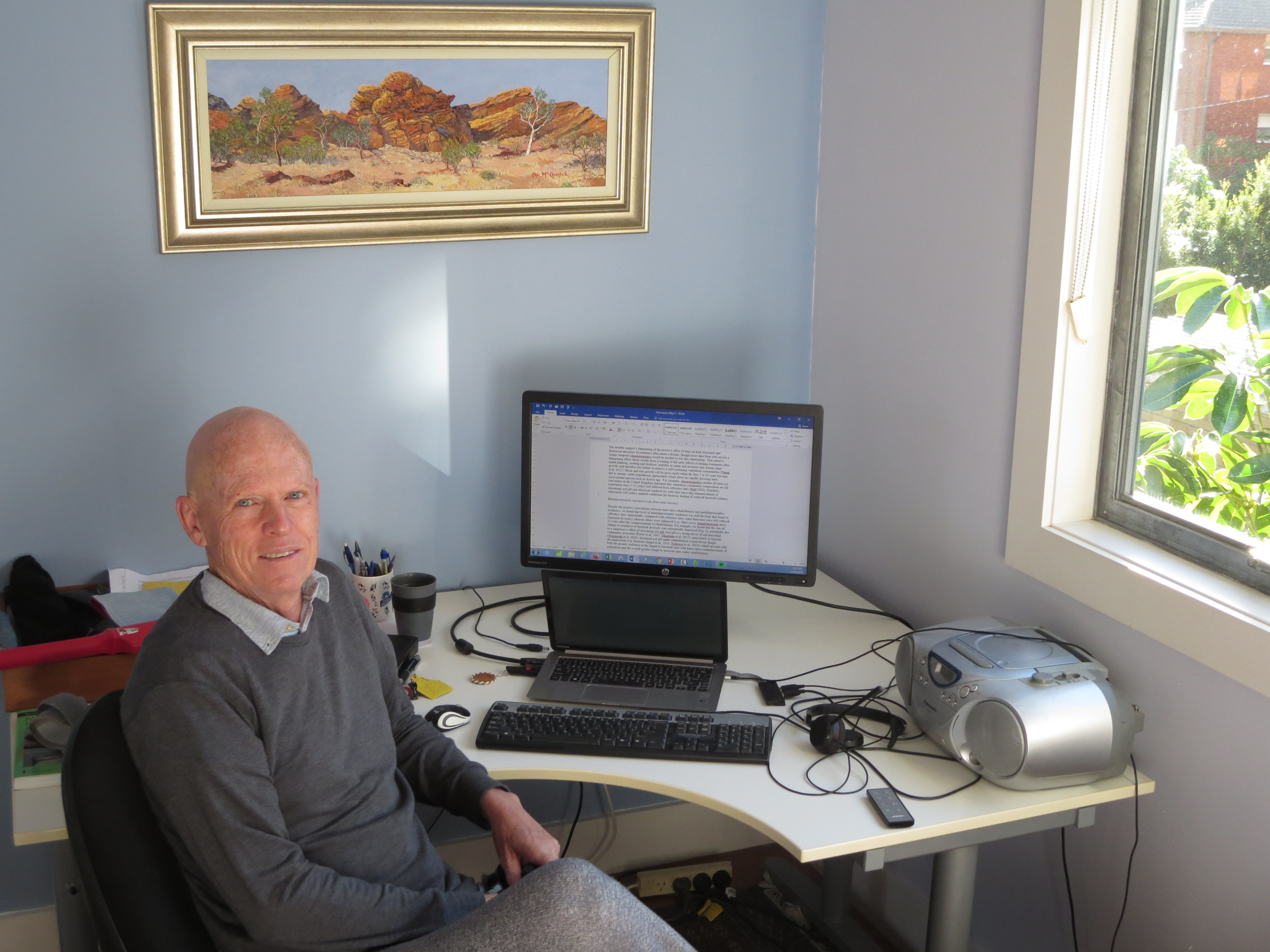
David Eldridge in his home office

I am a Senior Principal Research Scientist with a government agency in Sydney, Australia and a Professor at the University of New South Wales in Sydney. Most of my work focuses on understanding land management impacts in drylands. About 70% of Australia is arid or semiarid, so there are plenty of problems and issues to tackle. I’m particularly interested in the impacts of livestock grazing and woody plant encroachment on soil and ecological processes.

Compared to most parts of Europe and Asia, we have been quite fortunate in Australia that we have lost relatively few people (less than 100) due to the virus. Since about mid-March there have been huge restrictions on our daily activities; cafes, hotels, and beaches all closed, schools and some universities closed, and most people encouraged to work from home. For me it meant cancelling my trips to Spain and China, and despite the fact that I have taken a 12-month sabbatical, I can’t really go anywhere.

Six weeks after the start of the COVID19 (semi) lockdown in Sydney, I did a quick straw poll of half a dozen academic friends to see how they were coping with working from home. Not surprisingly, those with small children were finding it hard to focus and adjust; those with small children, teaching or developing distance education packages were finding it much more difficult to cope with children at home and to feel that they were making some progress. This is clearly more difficult for early career women, who are the primary caregivers, having to juggle family work and new methods of distance education.

As a late career academic, the lockdown has been relatively painless for me. I enjoy being on my own, I don’t have to go to work, our son has long left home, I have a nice sunny home office, and as long as I ‘keep out of her way’, my wife is happy to have me working from home. As one of my introverted academic friend said to me recently; ‘I been practising for this for years’. The advantage of being a late career academic is that there I have many half-finished manuscripts that I can finally finish writing up. And if all of that ever gets done (unlikely), I still have more than 30 years of data that I can rework and explore. No wonder my Spanish friends call me ‘data piñata’.

A major problem, however, is that we cannot visit the field or even the glasshouse, so this has been very stressful, particularly for students or academics with long-term data commitments. One of my PhD students, Max, has a 3 year field-based climate change experiment coming up to its last measurement. He is very anxious about whether they will let him finish this vital field work. Many others are in similar situations, causing considerable uncertainty and frustration.

Even for me though, it is not always easy to maintain momentum when isolated from friends, my favourite cafe (yes I know, it’s a First World problem), my swimming or my usual yoga classes. I have had to develop some strategies to help me get through the day.  Many of you have your own tips and tricks, but these are those that work for me.

Maintain a routine: I try to get up at the same time in the morning, don’t lounge around in my pyjamas, and dress as if I’m going to work. This makes me feel like I’m at work rather than at home.

Exercise: I can’t go to yoga and I can’t go swimming, but I have found so many fantastic YouTube yoga classes to keep me sane, and I’m actually really enjoying them.

Regular contact: I try to talk with my students every two or three days; it’s not the same as face-to-face, but it helps to keep us all focused and to make us all feel part of a team.

Plan ahead: there will be a life after COVID19, so I’ve been thinking about what I want to do when all this is over; all of those great experiments I’ve been dreaming about while stuck indoors.

Show compassion and understanding: I’m an Editor of a couple of journals, but I don’t expect reviewers to be as available, or as quick to respond as I might be, as they might have been under normal situations. Cut them a bit of slack.

And finally, this one is probably the most important.

Be kind to yourself: mental health is a huge issue during the pandemic and is likely to continue after we resume our normal activities. You may find that you are not as productive, or that it is more difficult to write, or just to concentrate. Acknowledge that it is okay to feel like this. And remember, ‘If you get sick or need assistance, your papers will not take care of you’ (Anon. Twitter).

Also of interest:

Mehdi Abedi’s post on Ecology during Covid – Iran.

Chuck Fox looks into The representation of women as authors of submissions to ecology journals during the COVID-19 pandemic

Christian Imholt & Anna Obiegala explore Land-use, biodiversity and zoonotic diseases

Methods.blog : Working from Home, Isolation and Staying Sane

Share this:

  • Share on X (Opens in new window) X
  • Share on Facebook (Opens in new window) Facebook
Like Loading...

Related

Unknown's avatarBritish Ecological Society3 Jun 20201 Jun 2020coronavirus, COVID-19, first-hand account, lockdown

3 thoughts on “Ecology during covid – in Australia”

  1. Pingback: Ecology during Covid – Brazil – Functional Ecologists – A blog for the people behind the research
  2. Pingback: Ecology during Covid – Spain – Functional Ecologists – A blog for the people behind the research
  3. Pingback: Ecology during Covid – USA – Functional Ecologists – A blog for the people behind the research

Leave a comment Cancel reply

Post navigation

Previous Previous post: Kechang Niu: A plant’s perspective
Next Next post: Ana Salgado: Butterfly oviposition preference affects offspring survival

The official blog of Functional Ecology, a British Ecological Society Journal

Enter your email address to subscribe to this blog and receive notifications of new posts by email.

Join 333 other subscribers
Follow Functional Ecologists on WordPress.com

Other BES blogs

Methods.blog
Journal of Ecology Blog
The Applied Ecologists Blog
Animal Ecology In Focus
Relational Thinking

Top Posts & Pages

  • The 27th International Ornithological Congress (August 19-26, 2018)
  • Curtis Lubbe: Going Belowground in Central European Meadows
  • Functional Ecology now requires a ‘Replication Statement’ for all submitted Research Articles
  • Manuel López-Aliste | Differential effects of agricultural expansion on wild bee taxonomic and functional diversity
  • Ecologist's Diary with Richard Beason: If a tree falls in the forest and no one hears it... it does make a sound!

Tags

biodiversity birds Black Ecologists Black History Month Black in STEM climate change community ecology early career Ecology ecr Editorial Board first-hand account functional traits haldane prize Journal Updates Meet the Editor phd plant-animal interactions plant physiology plants

Follow us on Twitter

My Tweets

Enter your email address to subscribe to this blog and receive notifications of new posts by email.

Join 333 other subscribers
Follow Functional Ecologists on WordPress.com

RSS

  • RSS - Posts

BES journal blogs

Methods.blog
Journal of Ecology Blog
The Applied Ecologists Blog
Animal Ecology In Focus
Relational Thinking

Tags

animal behaviour animal physiology bees behaviour behavioural ecology Behind the paper biodiversity birds Black Ecologists Black History Month Black in STEM Brazil climate change Community community ecology conferences conservation coral reefs coronavirus COVID-19 decomposition diversity drought early career Ecology ecophysiology ecosystem ecology ecosystems ecology ecr Editorial Board Events evolution evolutionary ecology fieldwork first-hand account forests frugivory Functional Ecology functional traits global warming haldane prize Haldane Prize 2022 herbivory invasive species Journal Update Journal Updates lgbt+ lizards Meet the Editor nature nutrient cycling phd PhDs around the world phenology physiology plant-animal interactions plant ecology plant functional traits plant physiological ecology plant physiology plants podcast podcast transcript pollination Postcards From The Field predation pride research soil ecology special feature temperature traits Translation trees tropical forest

Archives

Enter your email address to subscribe to this blog and receive notifications of new posts by email.

Join 333 other subscribers
Follow Functional Ecologists on WordPress.com

RSS

  • RSS - Posts

BES journal blogs

Methods.blog
Journal of Ecology Blog
The Applied Ecologists Blog
Animal Ecology In Focus
Relational Thinking

Top Posts & Pages

  • The 27th International Ornithological Congress (August 19-26, 2018)
  • Curtis Lubbe: Going Belowground in Central European Meadows
  • Functional Ecology now requires a ‘Replication Statement’ for all submitted Research Articles
  • Manuel López-Aliste | Differential effects of agricultural expansion on wild bee taxonomic and functional diversity
  • Ecologist's Diary with Richard Beason: If a tree falls in the forest and no one hears it... it does make a sound!
  • Key Concepts in Ecology: Mutualisms and Facilitation 
  • Las aves frugívoras ajustan su dieta para alcanzar sus objetivos nutricionales
  • 2025 Haldane Prize shortlist: Functional Ecology's Award for Early Career Researchers
  • Xiaojuan Feng: microbial Carbon use efficiency did not consistently differ between particulate and mineral-associated organic matter
  • Amber Wright: Sticky toes and grippy claws

Archives

Follow me on Twitter

My Tweets

Tags

behavioural ecology biodiversity birds Black Ecologists Black History Month Black in STEM climate change community ecology conferences early career Ecology ecophysiology ecr Editorial Board Events first-hand account functional traits haldane prize Journal Updates Meet the Editor phd plant-animal interactions plant ecology plant physiology plants
  • Home
  • About Us
  • Behind the paper
  • Community+Ecology
  • Journal Content
  • Facebook
  • Twitter
  • YouTube
  • Podcasts
Website Built with WordPress.com.
  • Comment
  • Reblog
  • Subscribe Subscribed
    • Functional Ecologists
    • Join 333 other subscribers
    • Already have a WordPress.com account? Log in now.
    • Functional Ecologists
    • Subscribe Subscribed
    • Sign up
    • Log in
    • Copy shortlink
    • Report this content
    • View post in Reader
    • Manage subscriptions
    • Collapse this bar
 

Loading Comments...
 

    Privacy & Cookies: This site uses cookies. By continuing to use this website, you agree to their use.
    To find out more, including how to control cookies, see here: Cookie Policy
    %d