Quentin Willot | Endogenous colony dormancy shapes seasonal cold tolerance in temperate ants

In this week’s blog post, we’re working together to beat the cold! Discussing their paper: “Endogenous colony dormancy shapes seasonal cold tolerance in temperate ants” author Quentin Willot – a Marie Skłodowska-Curie Postdoc at Namur University, Belgium – guides us through how these social insects anticipate and adapt to the cold season. Quentin explains how two biological levels of organisation, the individual and the colony, interact to shape the seasonal acquisition of cold-tolerance in temperate ants based on an internal colonial time. Outside … Continue reading Quentin Willot | Endogenous colony dormancy shapes seasonal cold tolerance in temperate ants

Quentin Willot | Endogenous colony dormancy shapes seasonal cold tolerance in temperate ants (Français)

Dans l’article de blog de cette semaine, nous allons plonger dans l’univers des insectes et leur manière de vaincre le froid ! À travers son article intitulé « Endogenous colony dormancy shapes seasonal cold tolerance in temperate ants », l’auteur Quentin Willot nous explique comment les fourmis anticipent et s’adaptent à la saison froide. Il montre comment deux niveaux d’organisation biologique propres aux insectes sociaux (l’individu et la colonie) interagissent pour façonner l’acquisition saisonnière de la … Continue reading Quentin Willot | Endogenous colony dormancy shapes seasonal cold tolerance in temperate ants (Français)
Eusociality and the transition from biparental to alloparental care in termites: Podcast Transcript

In this podcast for Functional Ecology, Assistant Editor, Frank Harris, sits down with Thomas Chouvenc—Assistant Professor at the University of Florida—to discuss his recently published paper ‘Eusociality and the transition from biparental to alloparental care in termites.’ Thomas’ paper shows that, in eusocial insects, colony foundation is a critical bottleneck, where the founding individuals must engage in a temporary (but obligatory) parental care phase that … Continue reading Eusociality and the transition from biparental to alloparental care in termites: Podcast Transcript

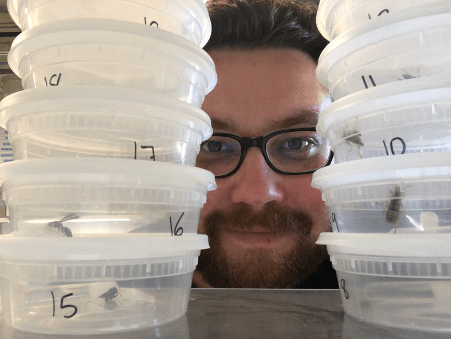
Alexander Walton with paper wasp workers, temporarily individually housed in deli cups.

Alexander Walton: Nutritional environment is an important regulator of aggression in paper wasps

 Dr. Alexander Walton, a Postdoctoral Researcher working collaboratively at Iowa State University and Cornell University, discusses with us his recent paper, “Resource limitation, intragroup aggression, and brain neuropeptide expression in a social wasp.” Nourishment can affect behaviour in many ways, including social behaviours. In this study, my co-author and I explored the link between a social animal’s nutritional environment and how cooperative or aggressive they … Continue reading Alexander Walton: Nutritional environment is an important regulator of aggression in paper wasps