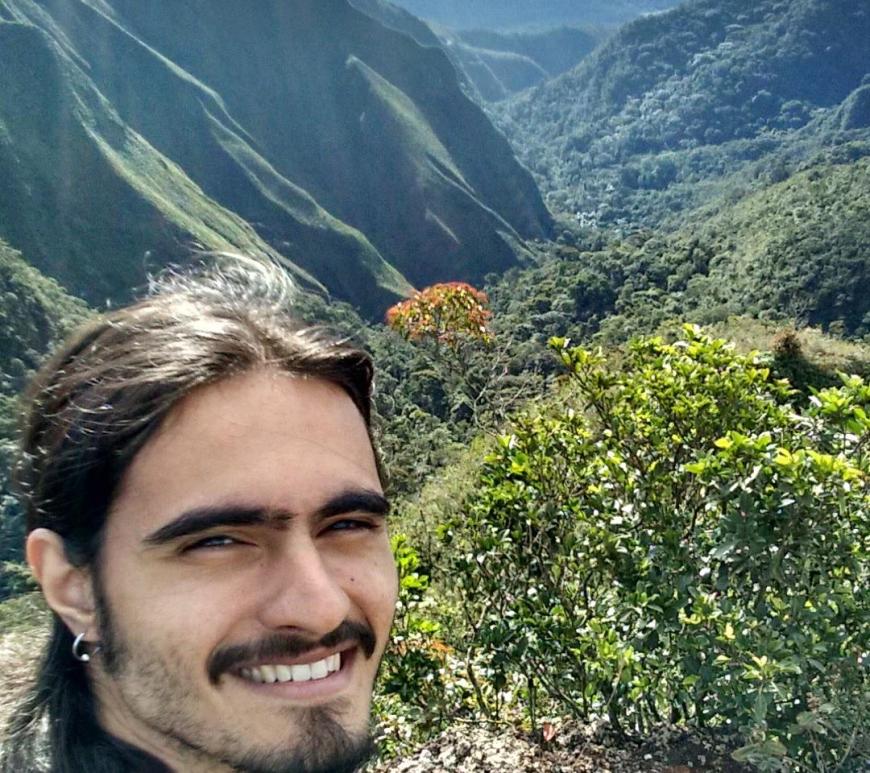
Haldane Prize 2025 | João Vitor Messeder: Rethinking the role of colour in avian fruit choices and foraging mechanisms

2025 HALDANE PRIZE SHORTLIST: João Vitor Messeder discusses the paper “Rethinking the role of colour in avian fruit choices and foraging mechanisms“, which has been shortlisted for Functional Ecology’s 2025 Haldane Prize for Early Career Researchers. About the paper Whether in a supermarket or hiking in the tropics, you may have wondered about the amazing diversity of fleshy fruits. Similarly, ecologists have long questioned the functional … Continue reading Haldane Prize 2025 | João Vitor Messeder: Rethinking the role of colour in avian fruit choices and foraging mechanisms

Haldane Prize 2025 | Kentaro Takagi: Realized flower constancy in bumble bees: Optimal foraging strategy balancing cognitive and travel costs and its possible consequences for floral diversity

2025 HALDANE PRIZE SHORTLIST: Kentaro Takagi discusses the paper “Realized flower constancy in bumble bees: Optimal foraging strategy balancing cognitive and travel costs and its possible consequences for floral diversity“, which has been shortlisted for Functional Ecology’s 2025 Haldane Prize for Early Career Researchers About the Paper Have you ever stopped to watch a pollinator moving among the blossoms? Interestingly, pollinators like bumble bees often show … Continue reading Haldane Prize 2025 | Kentaro Takagi: Realized flower constancy in bumble bees: Optimal foraging strategy balancing cognitive and travel costs and its possible consequences for floral diversity

Haldane Prize 2025 | Jiangnan Li: Linking rock outcrop size and distance to soil multifunctionality in mountain ecosystems

2025 HALDANE PRIZE SHORTLIST: Haldane Prize 2025 | Jiangnan Li discusses the paper “Linking rock outcrop size and distance to soil multifunctionality in mountain ecosystems“, which has been shortlisted for Functional Ecology’s 2025 Haldane Prize for Early Career Researchers. About the Paper In our paper, we investigate how rock outcrop size and distance influence soil multifunctionality in mountain ecosystems. We aim to understand how these … Continue reading Haldane Prize 2025 | Jiangnan Li: Linking rock outcrop size and distance to soil multifunctionality in mountain ecosystems

Haldane Prize 2025 | Lifeng Wang: Soil fauna trophic multifunctionality mediates the release of elements from decomposing typhoon-generated leaf litter

2024 HALDANE PRIZE SHORTLIST: Lifeng Wang discusses the paper “Soil fauna trophic multifunctionality mediates the release of elements from decomposing typhoon-generated leaf litter“, which has been shortlisted for Functional Ecology’s 2025 Haldane Prize for Early Career Researchers About the paper Typhoons cause large pulse fluxes of leaves that have not undergone senescence (i.e. green litter) to forest soils, with consequences for biogeochemical cycling. Elements released … Continue reading Haldane Prize 2025 | Lifeng Wang: Soil fauna trophic multifunctionality mediates the release of elements from decomposing typhoon-generated leaf litter

Haldane Prize 2025 | Jiawei Zhang: Spatial distribution and driving factors of microbial necromass carbon in coastal wetlands of China

2025 HALDANE PRIZE SHORTLIST: Jiawei Zhang discusses the paper “Spatial distribution and driving factors of microbial necromass carbon in coastal wetlands of China“, which has been shortlisted for Functional Ecology’s 2025 Haldane Prize for Early Career Researchers. About the Paper Our paper explores how microbial necromass carbon (MNC)—carbon derived from dead microorganisms—is distributed across China’s coastal wetlands and what drives its accumulation. Coastal wetlands are key … Continue reading Haldane Prize 2025 | Jiawei Zhang: Spatial distribution and driving factors of microbial necromass carbon in coastal wetlands of China

Haldane Prize 2025 | Carolina Olguín-Jacobson: Recovery mode: Marine protected areas enhance resilience of invertebrate species from marine heatwave

2025 HALDANE PRIZE SHORTLIST: Carolina Olguín Jacobson discusses her paper “Recovery mode: Marine protected areas enhance resilience of invertebrate species from marine heatwaves”, which has been shortlisted for Functional Ecology’s 2025 Haldane Prize for Early Career Researchers About the paper Imagine your town was suddenly hit by an extreme heatwave, not for a few days, but for months or even years. And imagine you couldn’t … Continue reading Haldane Prize 2025 | Carolina Olguín-Jacobson: Recovery mode: Marine protected areas enhance resilience of invertebrate species from marine heatwave

2025 Haldane Prize shortlist: Functional Ecology’s Award for Early Career Researchers

The Haldane Prize is awarded annually by the British Ecological Society for the best paper in Functional Ecology by an early career author. We are pleased to present the shortlisted papers for the 2025 award (published in Volume 39): ⭐️ Carolina Olguín-Jacobson: Recovery mode: Marine protected areas enhance climate resilience of invertebrate species to marine heatwaves ⭐️June Shrestha: Marine protection and environmental forcing influence fish-derived nutrient cycling in kelp forests ⭐️Jiawei Zhang: … Continue reading 2025 Haldane Prize shortlist: Functional Ecology’s Award for Early Career Researchers

Associate Editor (Blog) – Functional Ecology

Functional Ecology is seeking a new Editor to help run its highly successful blog site, Functional Ecologists We are currently looking for a new Blog Editor, with a broad interest in animal ecology, to continue delivering high-quality content on the blog. As well as highlighting journal content, the blog is a platform for discussing topics of more general interest to our readership and ecologists in general. … Continue reading Associate Editor (Blog) – Functional Ecology

Meet The Editor: Michael P. Moore

Current Institution: University of Colorado Denver, USA Research interests: I study how physiology and ontogeny limit the ways that organisms adapt to their environments. I am especially interested in using information about these constraints to better forecast how organisms will respond to global change. Why did you choose to study your particular area of research? When I started graduate school, there was a ton of … Continue reading Meet The Editor: Michael P. Moore