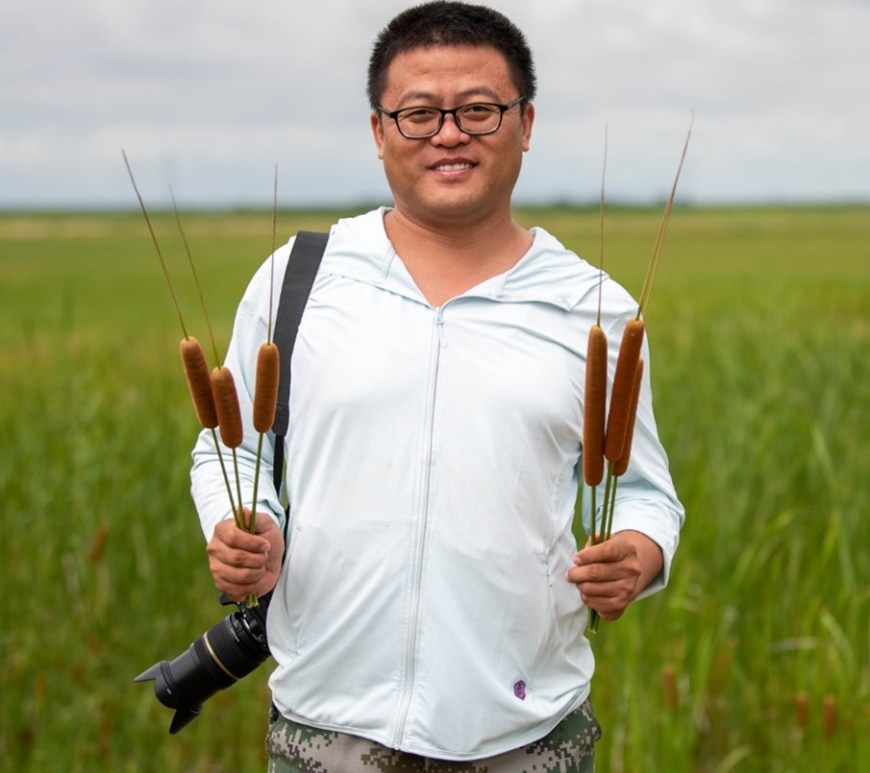
Changjin Cheng: A novel perspective when assessing the effect of plant community structure on productivity—The spatial aggregation of individual neighborhoods


In this new post, Changjin Cheng—a PhD candidate from the School of Ecology and Nature Conservation, Beijing Forestry University, China—presents his latest work ‘Spatial Assembly of Grassland Communities and Interrelationships with Productivity’. Changjin discusses the critical role of spatial aggregation in predicting the effects of environmental change and their journey towards becoming an ecologist. 此博文的中文版本可在此处获得 About the paper The assembly mechanism of plant diversity and … Continue reading Changjin Cheng: A novel perspective when assessing the effect of plant community structure on productivity—The spatial aggregation of individual neighborhoods

程昌锦: 评估群落结构对生产力影响的新视角: 植株个体邻域空间聚集效应

An English version of this blogpost is available to read here. 关于论文 植物群落结构与生态系统功能的关系一直是生态学界关注的焦点之一。过去几十年多样性-生态系统功能关 (BEF) 的研究已经被大量报道。然而,近些年不少学者对BEF能否为我们应对全球变化提供有价值的信息提出了质疑。质疑的一个重要基础:BEF的观测和控制实验的结果并不一致。尽管许多研究人员认为在物种相互作用十分强烈的局域群落,多样性参数与群落动态的薄弱联系是 (BEF) 结果不统一的重要原因;但是,目前人们还并未找到合适的解决方案。面对这一科学难题,我们提出可从植株个体邻域空间结构的视角,重新审视群落结构与生产力的关系。理论上,对于固着的植物而言,植物之间的相互作用主要发生在其邻域空间尺度;因此,植株个体邻居的身份(同种或异种)将与群落动态及生产力密切相关。 关于研究 本研究首次将每株检尺定位的方式应用于草地生态系统的野外样带调查。并基于2个温带草原(黄土高原和蒙古高原)和1个高寒草原(青藏高原)上125,726株植物在1m2样方内的相对位置坐标,阐明了植物邻域空间聚集的构建机制以及其与地上净初级生产力(ANPP)的关系。 研究结论验证了如下两个科学假设:(1)在海拔相对较低的温带草原(黄土和蒙古高原),更多的无性繁殖投入是种内聚集的主导因素(内源过程主导);而在拥有极端环境条件的青藏高原,高强度的环境过滤效应导致的物种多样性差异主导了邻域空间结构的变异(外源过程主导);(2)与物种多样性和系统发育多样性相比,邻域空间结构对ANPP空间变异的影响更大。 关于作者 我是北京林业大学生态与自然保护学院的一名博士生。对大自然的观察是我科研灵感的最大来源。我想知道这些现象背后正在发生什么,为什么发生,以及它对生态系统意味着什么。我认为自然界中一个非常耐人寻味的现象是植物能够通过自组织行为创造适应环境的空间结构(尽管采用固着的生活方式),进而影响物种共存和生态系统功能。这个视角将是我未来研究工作的重点。 中科院地理资源所何念鹏团队与北京林业大学孙建新团队联合完成了本项研究。其中,何念鹏团队创新性地发展了植物功能性状网络 (Plant trait networks, PTNs), 植物群落性状 (Plant community traits, PCTs), 生态系统功能性状 (Ecosystem traits, ESTs) 以及基于植物群落功能性状预测生产力的理论框架 (Traits-based Productivity, TBP)。如果您也对这方面的研究感兴趣,可以与他联系交流。 喜欢这篇博文吗?在这里阅读研究 Continue reading 程昌锦: 评估群落结构对生产力影响的新视角: 植株个体邻域空间聚集效应

Yankun Zhu: A long-term precipitation manipulation field experiment in a shrub-encroached grassland in Inner Mongolia, China

In this new post, Yankun Zhu—Associate Professor at Sanming University, China—discusses his paper: Increased precipitation attenuates shrub encroachment by facilitating herbaceous growth in a Mongolian grassland—recently shortlisted for the 2022 Haldane Prize for Early Career Researchers. About the paper Widespread shrub encroachment is profoundly impacting the structures and functions of global drylands, and precipitation change is assumed to be one of the most critical factors … Continue reading Yankun Zhu: A long-term precipitation manipulation field experiment in a shrub-encroached grassland in Inner Mongolia, China

Matthew Krna: Decomposition rates of leaf litter are temperature-independent

In this new post, Matt Krna—then a PhD student at Massey University, New Zealand—discusses his recently published paper in Functional Ecology: Temperature dependency of litter decomposition is not demonstrated under reciprocal transplantation of tussock leaves along an altitudinal gradient. This research follows on from his publication on clarifying carbon sequestration (Krna and Rapson, 2013). In his study of decomposition across a 700 m altitudinal gradient … Continue reading Matthew Krna: Decomposition rates of leaf litter are temperature-independent

Jian-Yong Wang: What role do clonal plants play in our ecosystems?

In this new post, Jian-Yong Wang, a new ecological researcher working at Northeast Normal University, China, shares his paper: A meta-analysis of effects of physiological integration in clonal plants under homogeneous vs. heterogeneous environments—recently shortlisted for the Haldane Prize for Early Career Researchers. About the paper Clonal plants, i.e. those able to reproduce vegetatively, play important roles in many ecosystems. Connected individuals (ramets) can translocate … Continue reading Jian-Yong Wang: What role do clonal plants play in our ecosystems?

Hannah White

Hannah White: Looking at historical climate helps map current ecosystem stability

In this post Dr Hanna White, lecturer at Anglia Ruskin University in Cambridge, presents her latest work “Ecosystem stability at the landscape scale is primarily associated with climatic history”. She discusses how biodiversity could not be enough to maintain a stable plant productivity in a changing climate, the importance of ecosystem monitoring and why ecologists are a great community for doing science. About the Paper … Continue reading Hannah White: Looking at historical climate helps map current ecosystem stability