Mario Vallejo-Marín | The buzz of pollination and how plants stave off greedy bees 

In this week’s blog post, we’re learning all about buzz pollination between Bombus terrestris and Solanum rostratum! Author Mario Vallejo-Marín explains one of the most striking examples of evolutionary convergence in floral form – buzz pollinated flowers: “Gradual pollen release in a buzz-pollinated plant: Investigating pollen presentation theory under bee visitation”.   1. About the Paper In this paper, we used nectarless, buzz pollinated flowers, … Continue reading Mario Vallejo-Marín | The buzz of pollination and how plants stave off greedy bees 

Jennifer Apland: does flower temperature affect pollinator behaviour?

In this week’s blog post, we learn what’s the buzz about pollinators and their affinity to heat. Through her recently published paper: “Isolating the effects of floral temperature on visitation and behavior of wild bee and fly pollinators”, Jennifer explores how traits and behaviours of insect pollinators can shift according to varying flower temperatures under different environmental conditions. This work is crucial to help us … Continue reading Jennifer Apland: does flower temperature affect pollinator behaviour?

Aoife Cantwell-Jones: How Arctic bees interact with plants depends on body size variation and spatiotemporal context

Aoife Cantwell-Jones—a PhD student at Imperial College London, UK—shares with us the background behind her recently accepted paper, “Mapping trait versus species turnover reveals spatiotemporal variation in functional redundancy and network robustness in a plant-pollinator community.” She discusses nuances of bumblebee-plant interactions and the importance of researching mutualistic interactions to solve global change issues, as well as celebrating teamwork. About the paper The intricate interdependencies … Continue reading Aoife Cantwell-Jones: How Arctic bees interact with plants depends on body size variation and spatiotemporal context

Jessica Burrows: Hungry Bees-ness—Radiation exposure in contaminated landscapes such as the Chernobyl Exclusion Zone increases bumblebee feeding and metabolism

In this new post, Jessica Burrows—a fourth year PhD student based at the University of Stirling, Scotland—discusses her new paper ‘Ecologically relevant radiation exposure triggers elevated metabolic rate and nectar consumption in bumblebees’. Jessica’s PhD research is funded by the NERC IAPETUS doctoral training programme, and focuses on the effects of radiation levels found in the Chernobyl Exclusion Zone on invertebrates. About the Paper There … Continue reading Jessica Burrows: Hungry Bees-ness—Radiation exposure in contaminated landscapes such as the Chernobyl Exclusion Zone increases bumblebee feeding and metabolism

Alex Austin: You get what you’re given? Solitary bee larvae demonstrate the ability to regulate their nutritional intake

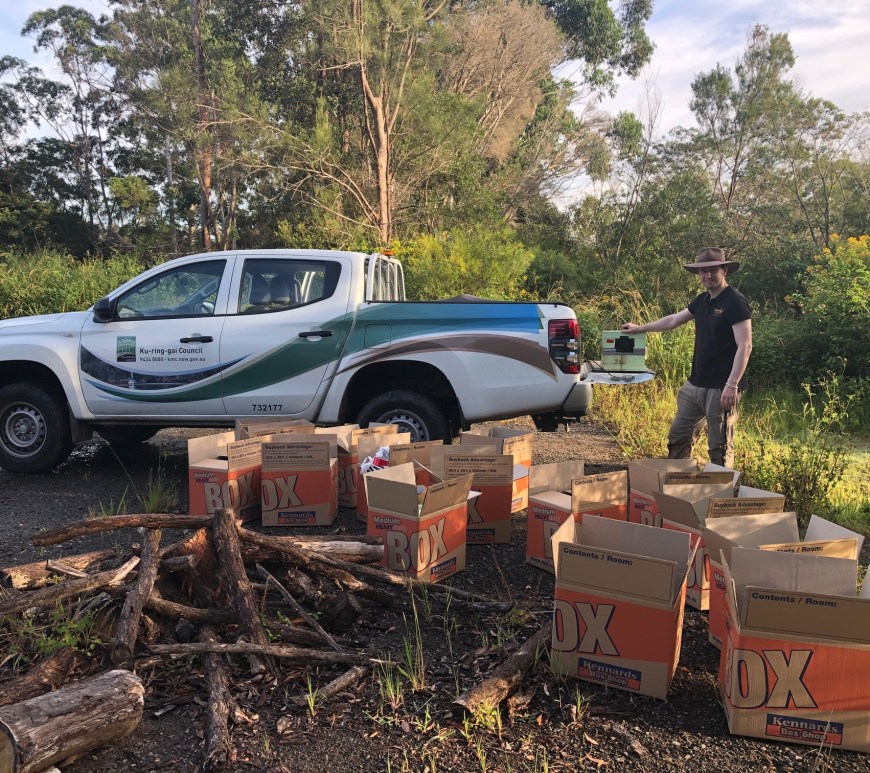
In this new post, Alexander Austin, a new ecological researcher working at Ku-ring-gai Council, Sydney, Australia, shares their paper: Solitary bee larvae prioritize carbohydrate over protein in parentally provided pollen—recently shortlisted for the Haldane Prize for Early Career Researchers. About the paper Nutrition is linked to almost every aspect of an animal’s behaviour and physiology, and we really wanted to explore this in solitary bees. … Continue reading Alex Austin: You get what you’re given? Solitary bee larvae demonstrate the ability to regulate their nutritional intake

Daniel Kenna

Daniel Kenna: Warming air temperature drives changes in bumblebee flight performance

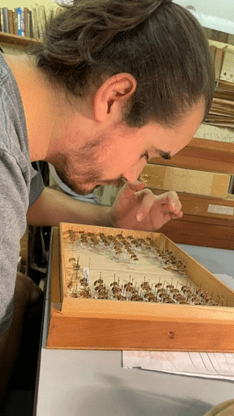
In this post, Daniel Kenna from Imperial College London’s Silwood Park Campus, explores how bumblebee flight responds to temperature change, discusses what this implies about the effects of climate change on our pollinators, and recounts his experiences in the lab. About the paper Bees’ flight performance affects their ability to pollinate plants, which is a crucial service for many of our crops and garden plants. … Continue reading Daniel Kenna: Warming air temperature drives changes in bumblebee flight performance

World bee day 2021: bee research collection

The 20th May marks world bee day, an opportunity for all of us to appreciate these little creatures that make our modern food economy possible. Bees are extremely valuable as pollinators and ecosystem services, but they are also fascinating creatures in their own right with complex social structures and communication methods. Here, we’ve curated our favourite bee-based research from Functional Ecology, as well as some … Continue reading World bee day 2021: bee research collection