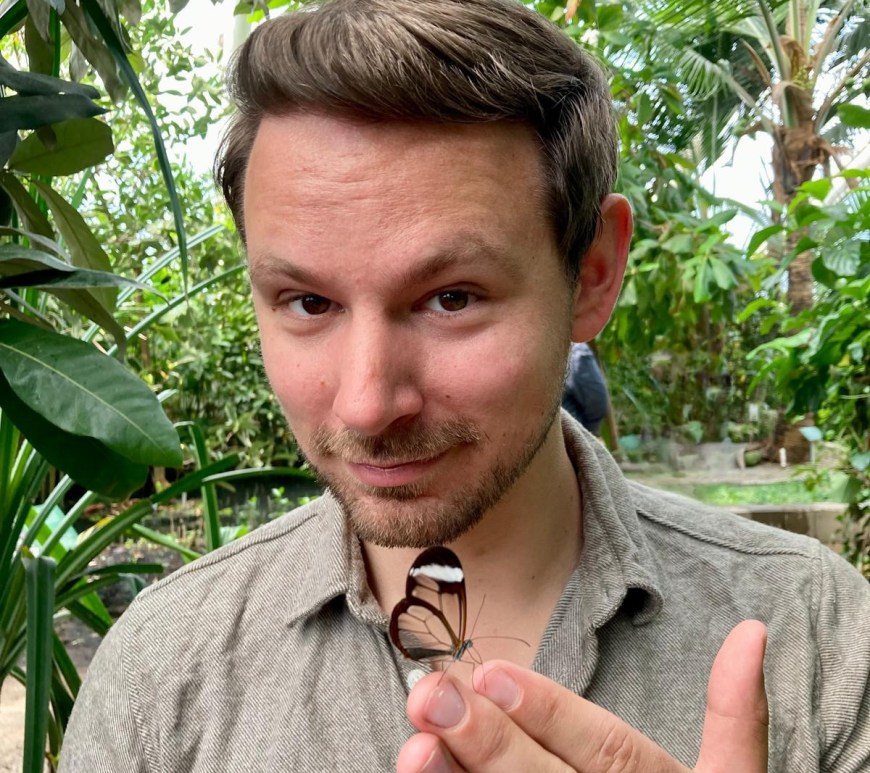
Quentin Willot | Endogenous colony dormancy shapes seasonal cold tolerance in temperate ants

In this week’s blog post, we’re working together to beat the cold! Discussing their paper: “Endogenous colony dormancy shapes seasonal cold tolerance in temperate ants” author Quentin Willot – a Marie Skłodowska-Curie Postdoc at Namur University, Belgium – guides us through how these social insects anticipate and adapt to the cold season. Quentin explains how two biological levels of organisation, the individual and the colony, interact to shape the seasonal acquisition of cold-tolerance in temperate ants based on an internal colonial time. Outside … Continue reading Quentin Willot | Endogenous colony dormancy shapes seasonal cold tolerance in temperate ants

Quentin Willot | Endogenous colony dormancy shapes seasonal cold tolerance in temperate ants (Français)

Dans l’article de blog de cette semaine, nous allons plonger dans l’univers des insectes et leur manière de vaincre le froid ! À travers son article intitulé « Endogenous colony dormancy shapes seasonal cold tolerance in temperate ants », l’auteur Quentin Willot nous explique comment les fourmis anticipent et s’adaptent à la saison froide. Il montre comment deux niveaux d’organisation biologique propres aux insectes sociaux (l’individu et la colonie) interagissent pour façonner l’acquisition saisonnière de la … Continue reading Quentin Willot | Endogenous colony dormancy shapes seasonal cold tolerance in temperate ants (Français)
Leo Ohyama: Navigating the ecological traits of insect societies

In this blog post, Leo Ohyama, a PhD candidate, discusses his study “Ecological traits of social insects: Colony, queen and worker size relationships reveal a nexus trait with broad ecological relevance“, which has been shortlisted for Functional Ecology’s 2023 Haldane Prize for Early Career Researchers. About the Paper Trait-based approaches in ecology allow researchers to associate ecological characteristics spanning phenology, morphology, and physiology to species … Continue reading Leo Ohyama: Navigating the ecological traits of insect societies

Alice Walker: Indirect control of decomposition by an invertebrate predator

In this new post, Alice Walker, a new ecological researcher at the School of Environmental Sciences, University of Liverpool, UK, discusses her paper: Indirect control of decomposition by an invertebrate predator—recently shortlisted for the 2022 Haldane Prize for Early Career Researchers. About the paper Most people have probably heard of vicious the “battles” that go on between ants and termites, thanks to the 1998 DreamWorks … Continue reading Alice Walker: Indirect control of decomposition by an invertebrate predator

María Natalia Lescano: The complex role of bottom-up cascading effects: Excess nutrients make aphids less attractive to mutualistic ants

In our latest post, María Natalia Lescano, researcher at CONICET and University of Comahue, discusses their paper ‘Excessive nutrient input induces an ecological cost for aphids by modifying their attractiveness towards mutualist ants’, whilst also showcasing their fantastic tri-trophic study system and discussing the importance of cascading effects in ecosystems. About the paper Ecological stoichiometry considers the balance of energy and elements on organisms and … Continue reading María Natalia Lescano: The complex role of bottom-up cascading effects: Excess nutrients make aphids less attractive to mutualistic ants