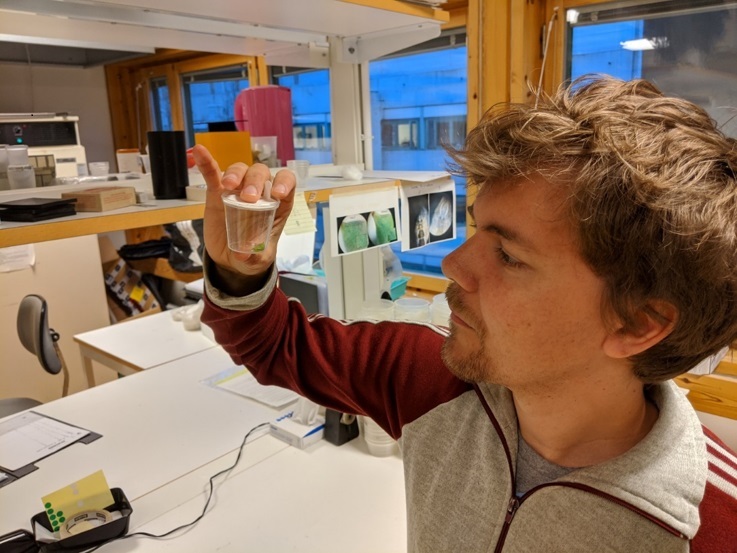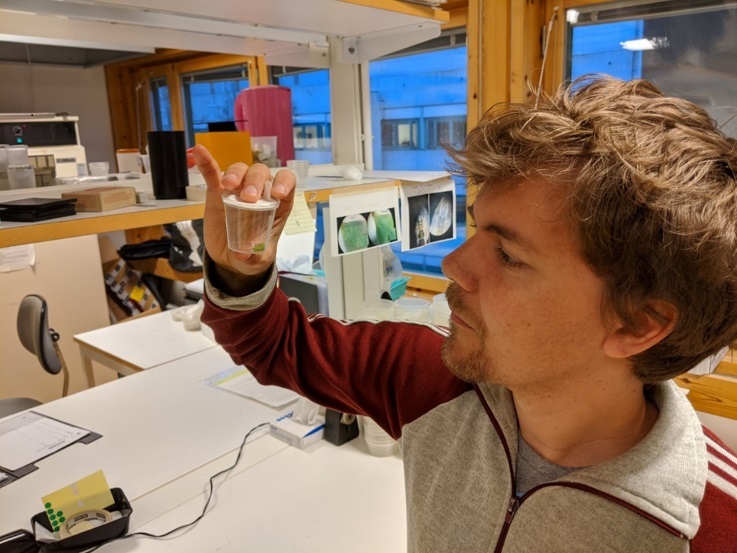
Moshe Zaguri: Do prey use safety cues to assess risk?

Moshe Zaguri, a Ph.D. candidate at The Hebrew University of Jerusalem, discusses his paper “Odours of non-predatory species help prey moderate their risk assessment”, the importance of this work, as well as his research interests.
Continue reading “Moshe Zaguri: Do prey use safety cues to assess risk?”
Javier del Campo: Microbiomes are more than bacteria, unveiling the eukaryome
In our latest Insight, Javier del Campo of the University of Miami talks about this new Review paper: The eukaryome: Diversity and role of micro‐eukaryotic organisms associated with animal hosts.
Continue reading “Javier del Campo: Microbiomes are more than bacteria, unveiling the eukaryome”
Simone Fontana: decomposition and division of labour
In our latest Q&A with an author, Simone Fontana talks about his recent paper, Intraspecific niche partitioning in macrodetritivores enhances mixed leaf litter decomposition, the background to this research and what led him to it.
Continue reading “Simone Fontana: decomposition and division of labour”
Maxwell Helmberger: microplastics in ecology

Microplastics—tiny plastic beads, fragments, and fibers released from personal care products, plastic waste, and laundering of synthetic fabrics—have long been understood to contaminate the ocean. Only recently have scientists learned they’re also prevalent in the soils human society depends on.
In our latest Insight, Maxwell Helmberger of Michigan State University talks about his new Review paper: Towards an ecology of soil microplastics, and what led him to write it.
Continue reading “Maxwell Helmberger: microplastics in ecology”
Carlos Bustos‐Segura: do herbivore parasitoids help plant fitness?
Jennifer Rudgers: answers from long-term data in the drylands
In this post, Jennifer Rudgers, Professor of Biology at University of New Mexico and the current Director of the Sevilleta Long-Term Ecological Research Program in New Mexico, talks about her recent paper, Sensitivity of dryland plant allometry to climate, and the importance of long-term data.
Continue reading “Jennifer Rudgers: answers from long-term data in the drylands”
Anna Abrahão: rocks, roots and resiliance
In this post, Anna Abrahão, of the Universität Hohenheim, Germany, talks about how plants – and people – set roots on rocky terrain. About the paper Our paper is about plants that grow on rock outcrops in a very nutrient-poor ecosystem in mountaintops of Brazil called campos rupestres. Theseplantshave incredible roots that allow them to dissolve rock and mine phosphorus. We called these roots vellozioid … Continue reading Anna Abrahão: rocks, roots and resiliance
Hugo Saiz: Looking forward to 2019 BES annual meeting in Belfast!
The time has come. The annual meeting of the BES will start in less than a week and every attendee is right now preparing for the upcoming week of Ecology.
Continue reading “Hugo Saiz: Looking forward to 2019 BES annual meeting in Belfast!”
Sam Bashevkin: Defense trade-offs for tiny plankton in the big sea

Sam Bashevkin, a marine ecologist in the Graduate Group in Ecology at UC Davis talks about looking at (mostly) transparent plankton, getting a lift with the Policía Ecológica and accepting imperfect studies.
Continue reading “Sam Bashevkin: Defense trade-offs for tiny plankton in the big sea”