Tamara Burgos: Thinking about seed dispersal patterns of mammal carnivores

In this blog post, Tamara Burgos, a postdoc at University of Cádiz, presents her paper “Apex predators can structure ecosystems through trophic cascades: Linking the frugivorous behaviour and seed dispersal patterns of mesocarnivores”.  Tamara explains how rewilding apex predators can affect key ecosystem functions such as seed dispersal and asks: why are mammal carnivores the main actors involved in this story? About the paper and … Continue reading Tamara Burgos: Thinking about seed dispersal patterns of mammal carnivores

Gisele Biem: Amazonian tree species differently invest in stem and twig wood depending on their environment 

In this new post Gisele Biem, postdoc researcher at National Institute for Amazon Research and State University of Mato Grosso, presets her work ‘Ecosystem type affects how Amazonian tree species invest in stem and twig wood’. She talks about the importance of wood density for trees, discusses how traits can upscale to global C models, and shares the beauty of her study sites.   About the … Continue reading Gisele Biem: Amazonian tree species differently invest in stem and twig wood depending on their environment 

Emily Holden: Plants prefer similar neighbours: increasing competition with higher trait dissimilarity.  

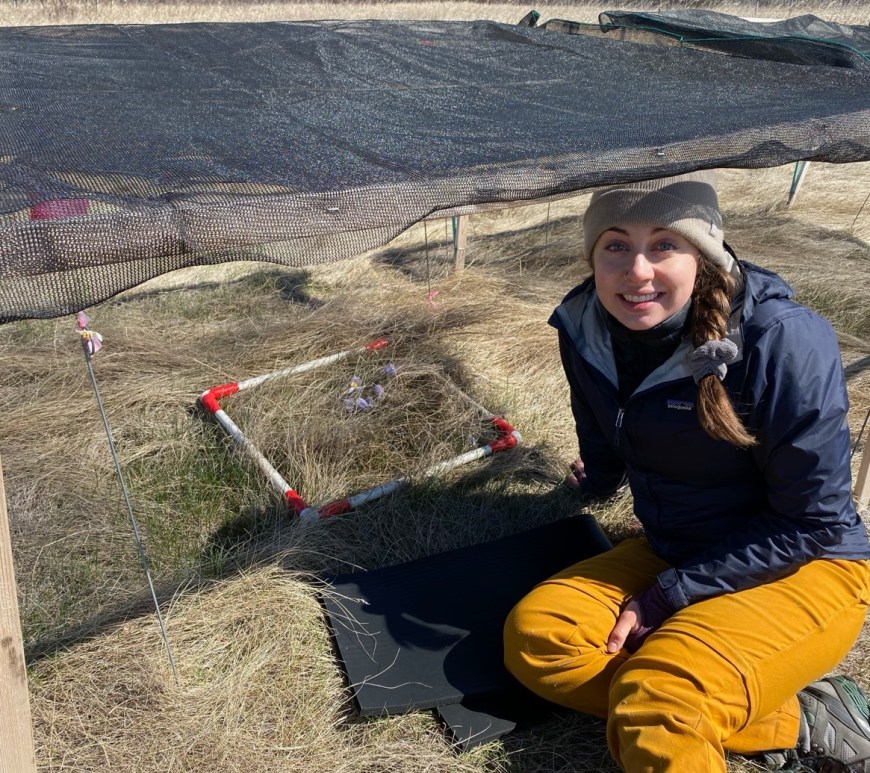
In our new post Emily Holden, PhD candidate at University of Alberta (Canada), presents her work ‘Plant trait dissimilarity increases competitive interactions among co-occurring plants’. She talks about confronting contrasting hypotheses, shares how she overcame COVID-19 to do her experiment, and celebrates her grandmother’s gardening skills.  About the paper  A foundational theory in ecology is that similar species will compete strongly as they share niche … Continue reading Emily Holden: Plants prefer similar neighbours: increasing competition with higher trait dissimilarity.  

Tom Martin and Penn Lloyd: What makes songbirds different in their breeding cycles?

In our latest post, authors Tom Martin and Penn Lloyd explore what makes songbirds different in their breeding cycles. Tom, a retired scientist of the University of Montana, and Penn, an ecological consultant in Queensland Australia, share insight behind their paper: “Potential drivers of differences in breeding phenology as a component of life history strategies among coexisting species”. They help explain the causes and consequences … Continue reading Tom Martin and Penn Lloyd: What makes songbirds different in their breeding cycles?

Tuğcan Alınç: Exploring multitrophic interactions: How beneficial soil microbes boost indirect plant defenses against herbivores

In our new post, Tuğcan Alınç, postdoctoral research at University of Palermo, presents his work ‘Root inoculation with beneficial soil microbes enhances indirect plant defenses induced by insect feeding and egg deposition’. He unveils the wonderful complexity of biotic interactions, discusses the importance of indirect paths for sustainable agriculture, and shares his inspiring visits to his grandfather’s farm.  About the paper  Plants have evolved various … Continue reading Tuğcan Alınç: Exploring multitrophic interactions: How beneficial soil microbes boost indirect plant defenses against herbivores

Lu Wang: Divergent microbial phosphorous acquisition strategies between active layer and permafrost deposits on the Tibetan Plateau

In this new post, Lu Wang, a Ph.D. student from the Institute of Botany, Chinese Academy of Sciences, China, discusses her recently published paper, “Divergent microbial phosphorous acquisition strategies between active layer and permafrost deposits on the Tibetan Plateau”. She delves into the research gap regarding phosphorus cycle in permafrost soils, highlights the challenges associated with measuring phosphorus acquisition strategies and shares her fascination for … Continue reading Lu Wang: Divergent microbial phosphorous acquisition strategies between active layer and permafrost deposits on the Tibetan Plateau

Els van de Zande: In the laboratory, greenhouse and field; how insects skins belowground can enhance the attraction of natural enemies of aboveground pest insects

Els van de Zande – a post-doc at Wageningen University, the Netherlands – presents her work ‘Enhanced parasitisation of caterpillars and aphids on field-grown Brassica oleracea plants upon soil amendment with insect exuviae’. She discusses how belowground changes can affect aboveground tri-trophic interactions, highlights a silver lining of the Covid-19 lockdowns and makes the case for investing time in volunteer work. About the paper Our … Continue reading Els van de Zande: In the laboratory, greenhouse and field; how insects skins belowground can enhance the attraction of natural enemies of aboveground pest insects

Kaz Uyehara on trade-offs during competition: Can plants have their cake and eat it too?

In this new post Kaz Uyehara, postdoc researcher at UC Davies, presents his work ‘Neighbour-detection causes shifts in allocation across multiple organs to prepare plants for light competition’. He explains how plants need to take critical decisions, shares his expertise about setting experiments and shows how it is possible to combine multiple passions, and even make a living out of it! About the paper Plants … Continue reading Kaz Uyehara on trade-offs during competition: Can plants have their cake and eat it too?

Kerstin Pierick: Above- and belowground strategies of tropical montane tree species are coordinated and driven by small-scale nitrogen availability 

In our last post Kerstin Pierick, postdoc at the University of Göttingen, discusses her last PhD thesis chapter ‘Above- and belowground strategies of tropical montane tree species are coordinated and driven by small-scale nitrogen availability’. She presents her astonishing study system, discusses the connection between environment and traits and remembers the importance of changing the point of view to understand nature.  A Spanish translation of … Continue reading Kerstin Pierick: Above- and belowground strategies of tropical montane tree species are coordinated and driven by small-scale nitrogen availability 

Kerstin Pierick: Las estrategias aéreas y subterráneas de las especies arbóreas montanas tropicales están coordinadas e impulsadas por la disponibilidad de nitrógeno a pequeña escala 

En nuestro último post, la postdoc Kerstin Pierick de la Universidad de Göttingen presenta el último capítulo de su tesis doctoral ‘Las estrategias aéreas y subterráneas de las especies arbóreas montanas tropicales están coordinadas e impulsadas por la disponibilidad de nitrógeno a pequeña escala’. Kerstin presenta su impresionante sistema de estudio, discute la conexión entre ambiente y rasgos, y nos recuerda la imporatncia de cambiar … Continue reading Kerstin Pierick: Las estrategias aéreas y subterráneas de las especies arbóreas montanas tropicales están coordinadas e impulsadas por la disponibilidad de nitrógeno a pequeña escala