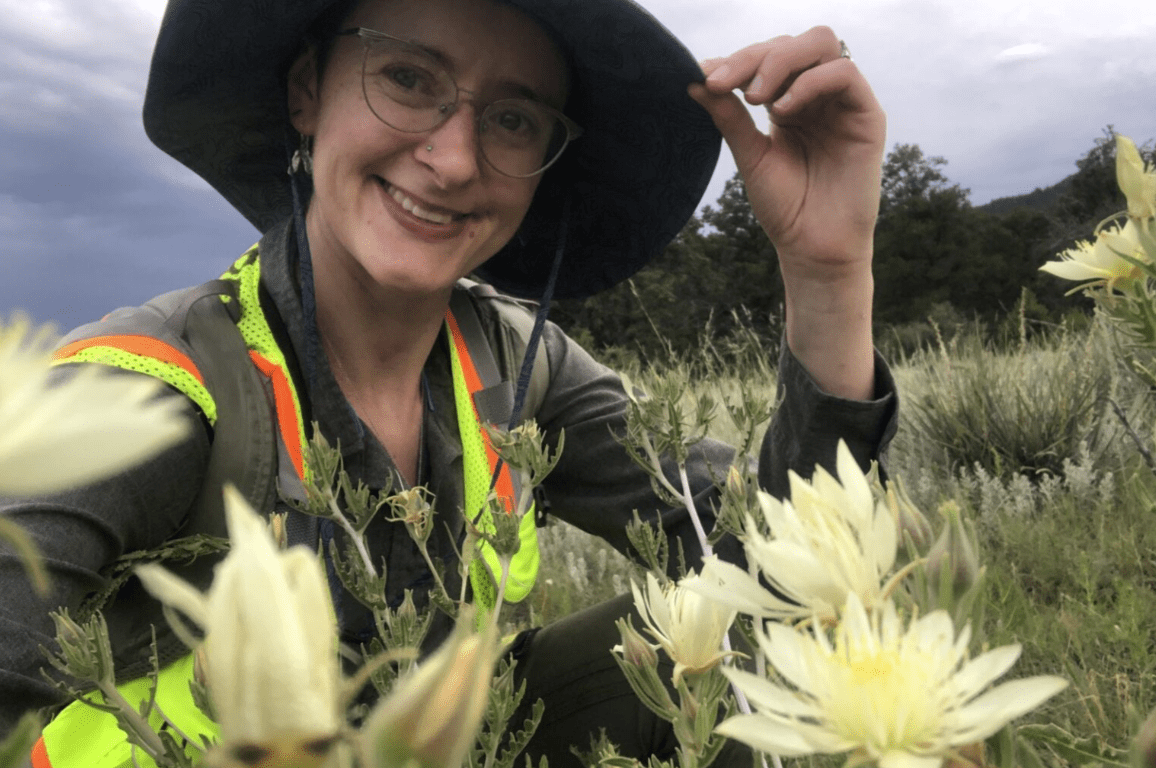
In this ‘Behind the Paper’ blog post, Rosemary Glos (she/her, University of Michigan, Ann Arbor, Mi, USA) discusses her research article ‘Separate and Synergistic Anti-Herbivore Effects of Non-Glandular Trichomes and Leaf Chemistry in a Desert Plant‘, which was recently published in Functional Ecology. Rosemary discusses synergistic interactions between plant defence traits, the utility of a beard-trimmer in the field, and the joys of roller derby!
1. About the Paper
Have you ever gotten scratched by a bramble, stung by a nettle or burned by poison ivy? If you answered “yes”, you know that plants have effective strategies for protecting themselves, and for good reason: many organisms, from tiny caterpillars to lumbering elephants, love to eat plants. Since plants can’t run, fly, or swim away, they have adopted other tactics for defending themselves against these herbivores. Most plants combine multiple defences to protect against a range of herbivores. There is also another reason why they might invest in several strategies at once: the effect of two or more defences working together might be greater than their individual effects combined (aka 1 + 1 > 2!). These defence synergisms have long been hypothesized, but they are rarely demonstrated with controlled experiments, which tend to focus on one defence trait at a time. If defence synergy is a viable strategy, it could give plants an (understudied!) advantage against their herbivores and might explain why certain combinations of defence traits are more common than others. In the long run, anything we learn about plant defence synergisms could be used to breed crop plants that are better protected against insect pests.
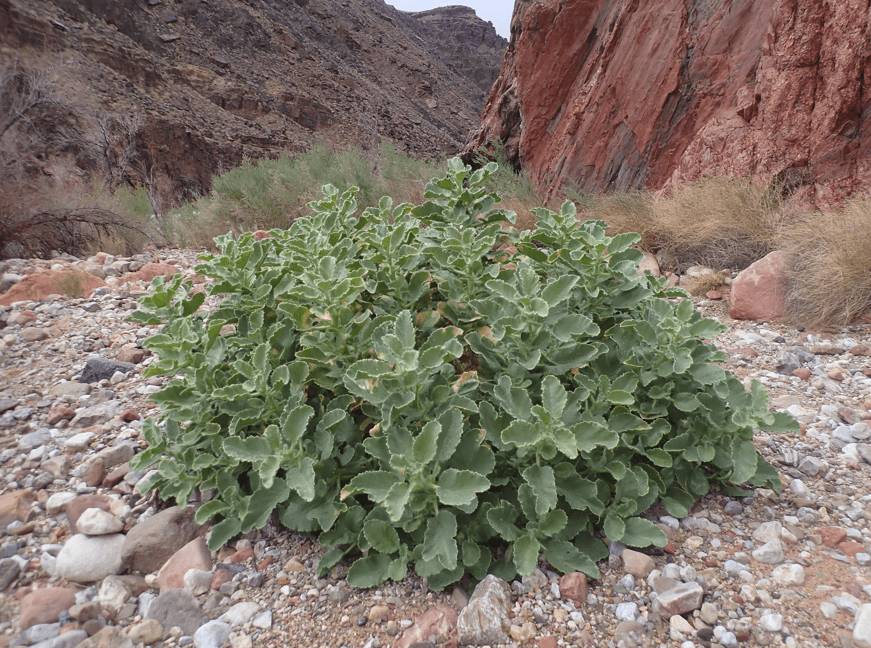
In our study, we tested for evidence of synergistic interactions between two common plant defence traits: sharp hairs called trichomes and bitter leaf chemicals. We chose to conduct our experiments with a plant called the “desert stingbush”, “rock nettle”, or “Velcro plant” (Eucnide urens, Loasaceae family), because it produces large trichomes that we could manipulate for our experiments. Rock nettle also makes two distinct trichome types, allowing us to secondarily test how trichome shape influences plant defence. Since not much is known about rock nettle’s natural herbivores, we studied its effects on the “lab rat” of caterpillars, a common agricultural pest called beet armyworm (Spodoptera exigua, Noctuidae). Beet armyworm caterpillars are voracious feeders on a wide range of plants and resemble herbivores that rock nettle would likely face in its native range (southwestern North America).
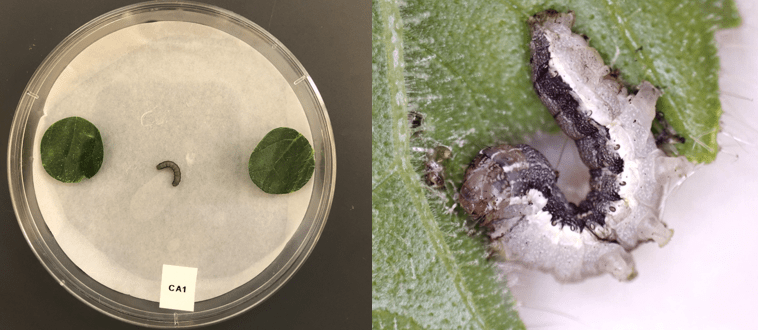
To test the separate and combined effects of rock nettle trichomes and leaf chemistry on armyworm caterpillars, we conducted three experiments. First, we wanted to know whether the trichomes make it hard for caterpillars to eat the leaves. Rock nettle is also called “Velcro plant” because glassy, barbed trichomes coat the undersides of its leaves, snagging anything that touches them. The upper side of the leaves are coated with smooth, but pokey, needlelike trichomes. In one experiment, we gave beet armyworm caterpillars a choice between high and low-trichome leaves. In the second experiment, we fed caterpillars one or the other and measured how much leaf they ate. You might wonder how we got those “low-trichome” leaves. The answer: we carefully shaved them off using a battery-operated trimmer designed for beards and moustaches (oh, the things we do for science!). Right away, it was clear that the barbed trichomes give armyworm caterpillars a rough time. Although they did not show an initial preference for low- or high-trichome leaves, caterpillars that fed on high-trichome leaves almost invariably became trapped by the tiny barbs, ate far less, and gained less weight than their counterparts on shaved leaves. Caterpillars that stayed on the barb-free upper side of the leaves had more luck, but one wrong move would snag their legs or jaws – sometimes permanently – on the carpet of hooked trichomes underneath.
Clearly, rock nettle trichomes have the potential to act as a powerful deterrent to herbivory, but what if an herbivore powers though and manages to eat the leaves? Do the trichomes have additional negative effects? What about the potential for synergistic interactions between the trichomes and chemical defences in the leaves? To answer these questions, we conducted a third experiment. Instead of giving caterpillars whole leaves, we raised them on grain-based artificial diets that contained either rock nettle trichomes, leaf extracts, both, or neither. This experiment necessitated another piece of sophisticated scientific equipment: the electric toothbrush. To collect the trichomes needed for the caterpillar diets, we dried rock nettle leaves and used the toothbrush to sweep trichomes off the surface (a satisfying task). Over the course of experiment, we measured caterpillar growth on each diet and recorded how many survived to become adult moths. We also used a scanning electron microscope to examine caterpillar frass (poop) to confirm that they were eating the trichomes and imaged their mouthparts to measure whether the stiff hairs damaged their jaws.
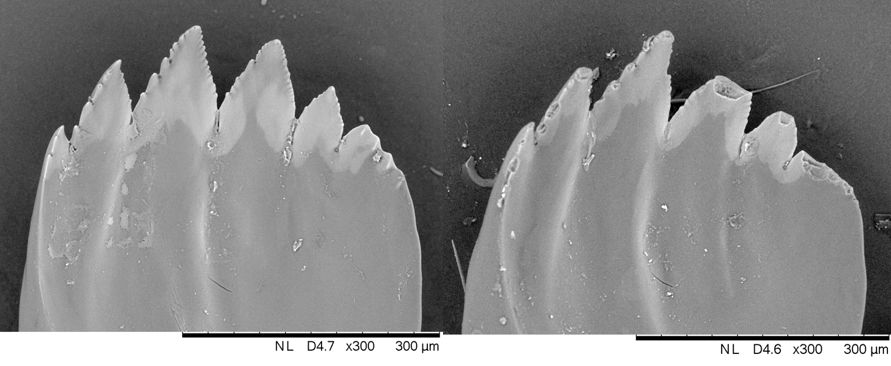
The diet experiment revealed several important pieces of information about rock nettle defences. Most notably, caterpillars that were fed both trichomes and leaf chemistry grew far less than caterpillars that ate just one defence on its own. The effect was strong enough to suggest a defence synergism: at their peak weight, caterpillars that experiences both defences were over 75% smaller than would be expected if trichomes and leaf chemistry operated additively. The effects of the individual defences provided some clues for why this synergism might occur. On their own, chemicals from rock nettle leaf extracts significantly slowed caterpillar growth and ultimately prevented them from pupating. We analysed the leaf extracts and found that they contained many chemical compounds known to deter and poison herbivores, including bitter chemicals called iridoids. Caterpillars that ate trichomes did okay at first, gaining the same amount of weight and pupating at the same rate as the group that didn’t eat plant defences (control). However, they experienced damage to their jaws from chewing on the hard trichomes and very few adult moths emerged from their pupae. Other scientists have shown that eating sharp crystals from plant leaves can physically damage herbivores in a way that makes them more susceptible to plant defence chemicals, so it’s conceivable that we observed a similar phenomenon with the glassy trichomes. Unlike beet armyworm, rock nettle’s native herbivores may be tolerant of trichomes and/or leaf chemistry individually, potentially making the synergism between them crucial for the plant’s defence.
All in all, this paper provided rare experimental evidence for synergism between physical and chemical plant defence traits and demonstrated ways that trichomes can hinder herbivores both before and after they start eating. Most plants have both chemical and physical defences, but we still don’t know whether synergy is a common strategy or limited to specific trait combinations. More research is needed to determine whether defence synergisms happen in other plant species and whether they can be harnessed to help economically important plants survive insect pests.
2. About the Author
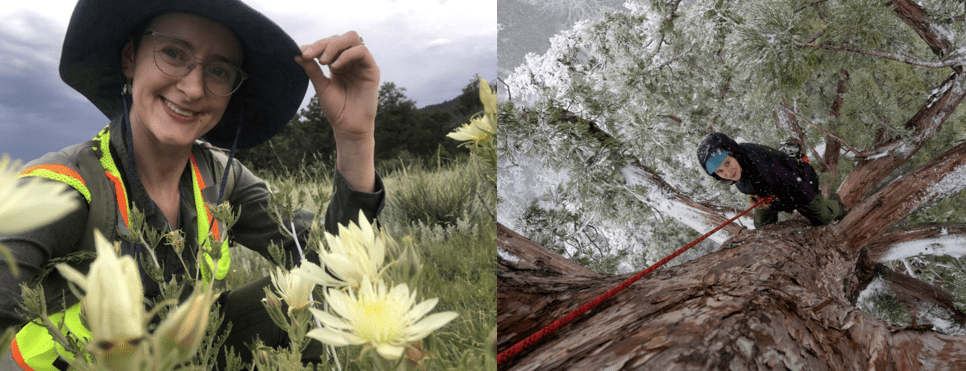
I am a PhD candidate at the University of Michigan, where I study how fine-scale morphological variation influences interactions between plants, herbivores, and mutualists. I grew up surrounded by plants and animals on a small farm in rural upstate New York, so I have always been passionate about ecology and the outdoors. Currently, I am fascinated by the ways that organisms balance and combine different strategies for protection from herbivores and predators. What trade-offs must they navigate? How do subtle, even microscopic morphological differences impact these interactions? Outside of research, I stay busy playing roller derby for Ann Arbor Roller Derby and the Team Michigan All-Stars. Roller derby is a fast-paced, full-contact sport that keeps me active when I’m not in the field. I also enjoy scientific illustration (it was my minor in undergrad) and rope-access climbing big trees with my partner. Big thanks to my advisor, Marjorie Weber, and my lab mate Abbey Soule for collaborating on this paper!
 Functional Ecologists