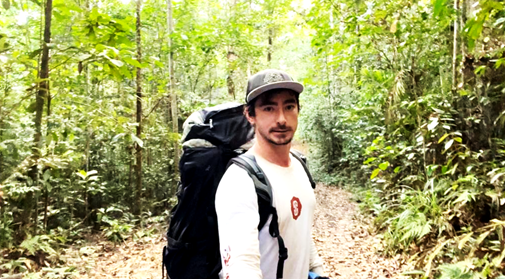
In this ‘Behind the Paper’ blog post we get into the roof of rainforests as the author Leonardo Ziccardi guides us through the unique world of ancient Amazonian trees from the article ‘Trait coordination reveals the fast-slow plant economics spectrum along the vertical canopy profile in central Amazonian forests‘. By climbing into the canopy and studying trait variation across species and forest layers, Leonardo, a PhD student at Michigan State University, explains how the emergent trees of the Amazon are much more than static giants—they are dynamic strategists.
A Portuguese translation of this blog post is available here.
1. About the Paper
What is the secret of ancient Amazonian trees to survive for so long until they finally emerge above the dense rainforest canopy? The answer to this question is crucial for understanding how tropical trees’ strategies are shaped by their ever-changing environment, offering insights into how tropical forests will respond to the accelerating pressures of climate change. By conducting several field campaigns climbing into the crowns of ancient giant trees in the heat of the Amazon rainforest, we explored how “fast” and “slow” resource acquisition strategies—and traits linked to them—are distributed along the vertical canopy profile.
In tropical forests, trees compete for resources and space across a vertical dimension that spans from the dark understory to the sun-exposed upper canopy. In our study, we investigated how tree function and growth change with height among locally dominant species at one of the most studied Amazonian sites. We found that height in the forest not only shapes hydraulic strategies and leaf traits, but also reorganizes how these traits interact and drive tree growth. We observed that trees transitioned from acquisitive (fast) to more conservative (slow) strategy of resource acquisition as they grow toward the upper canopy. In other words, we found that adaptive strategies and performance of large tropical trees shift with their vertical position in the canopy over their lifetime, expanding our understanding about tree resilience and forest dynamics.
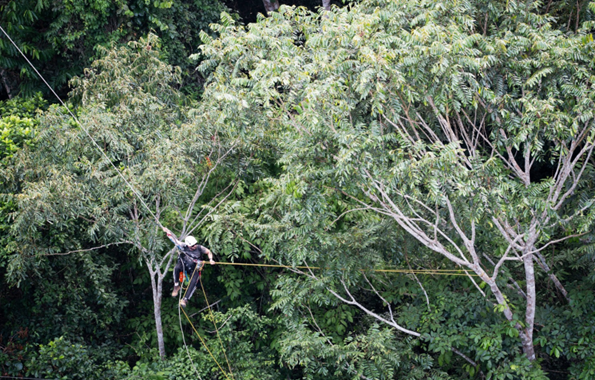
The broader impact of our study is to offer a new understanding of the vertical variation and adaptive strategies that influence tree growth in tropical forests. These insights reach far beyond a single forest or species: they reinforce the need for multiscale approaches to predict how tropical forests—critical for global carbon and climate regulation—will respond to ongoing environmental change. By quantifying the variation of key hydraulic and photosynthetic traits along the canopy profile, our work contributes to improving global vegetation models and their ability to forecast forest productivity, resilience, and response to climate change scenarios.
2. About the Research
Collecting the data needed to answer our research questions required sampling at multiple heights throughout the forest canopy—a task that requires both determination and courage. Although I was deeply motivated to dive into canopy ecology, I had no previous tree climbing experience—and, even more challenging, I was afraid of heights. Inspired by co-authors who had conducted extensive in-canopy research, Kleber Campos (also a co-author) and I set off for Panamá to attend a specialized canopy access training course. There, we spent 40 days in intensive tree climbing training with Griëtte van der Heide, a renowned tree climber and forest researcher. Armed with new skills and properly certified, Kleber and I returned to our field site near Santarém (Pará, Brazil), where we expanded the research team, and began our journey.
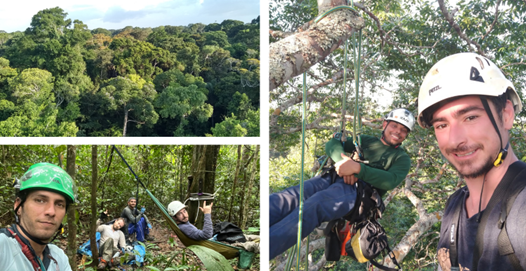
Navigating the height and complexity of the Amazon canopy provided plenty of daily challenges—from pounding rains and persistent insects to scorching days spent suspended in the crowns of trees. Careful planning, safety protocols, and collaboration with the local community were essential to minimize risk and succeed. Through long field campaigns conducted in 2019 and 2021, our team braved the ancient giants of Tapajós National Forest in the heart of Amazonia, ascending into the canopy to sample nearly 500 leaves from 162 branches across the vertical forest profile. Our canopy journeys revealed a world of secret strategies that help these ancient trees endure. Looking back, we had plenty of tough moments, and times where all of us were really exhausted from the intense fieldwork. But the challenges paid off: the difficulties faded in the light of discovery, and it was an unforgettable journey for both science and spirit.

All the effort and perseverance led us to a surprising insight. We found that ancient Amazon canopy trees are far more than static giants—they are dynamic strategists, continually adapting as conditions change toward the forest canopy. One of their greatest strengths is their incredible ability to adjust strategies in response to the diverse and shifting canopy environment as they grow older. We hope that future studies build on our findings by exploring these patterns over other hydrological landscapes and seasons. A natural next step would be investigating the vertical variation of trees’ responses to drought conditions, and extending fieldwork into the wet season—when accessing the canopy becomes an even greater challenge due to frequent rainstorms.
Leonardo was funded by the prestigious Future Investigators in NASA Earth and Space Science and Technology (FINESST) award from the Early Career Research Program in NASA’s Earth Science Division. This research was also supported by the National Science Foundation Division of Environmental Biology (NSF DEB). These grants, together with the logistic support from LBA (Large-Scale Biosphere-Atmosphere Experiment in Amazonia), were essential for making this research possible.
3. About the Author
Outside of research, I’m passionate about music, skateboarding, and art—following in the footsteps of my mom, who is a talented painter. I was born and raised in São Paulo, a big metropolis with over 12 million people. Despite my urban background, and maybe because of that, I’ve always been deeply fascinated and curious about nature—and especially the Amazon rainforest, which ultimately inspired me to pursue a career in forestry and research. My journey in science started with a BSc in Forestry at the Federal University of São Carlos, Brazil. Early research on forest fire risk indices taught me that knowing statistical tools that allow the asking of meaningful questions can lead to practical solutions for society. Later, during my MSc at the National Institute of Amazonian Research (INPA), my research investigating the effects of anthropogenic disturbances on bamboo-dominated forests with Dr. Philip Fearnside introduced me to the challenges and excitement of making important discoveries in the Amazon.
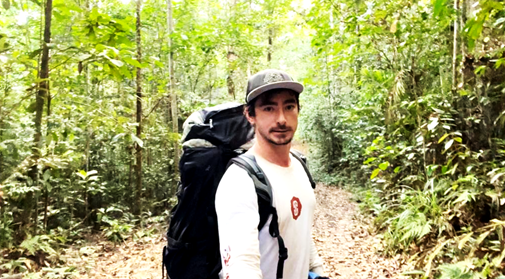
Currently, I am a PhD candidate in forestry at Michigan State University. Drawing from shared interests with my advisor, Dr. Scott Stark, I ventured into the world of canopy research—pushing my own limits to understand how leaves, trees and canopies respond to environmental change. I feel incredibly fortunate to have the opportunity to explore the roof of Amazonian forests—some of the most underexplored and fascinating places on Earth. I am deeply motivated to continue developing knowledge and solutions to help mitigate the possible catastrophic effects of ongoing climate change—a global challenge where tropical rainforests play a key role in regulating the planet’s future climate.
As with many early-career scientists, I’ve faced barriers such as limited funding, arduous fieldwork, and moments of doubt—challenges that have built my resilience and made me stronger. If I could give one piece of advice to my younger self, it would be: Trust the process; whatever happens as a consequence of embracing your purpose is the best thing that can happen.
 Functional Ecologists