Ximena and Juan (husband) preparing samples for carbon nitrogen analysis at HIE. Image courtesy of Ximena Cibils-Stewart

Silicon or symbionts? Grasses use both types of anti-herbivore defences

Ximena Cibils-Stewart recently submitted her doctoral dissertation at The Hawkesbury Institute for the Environment, Western Sydney University, and is currently an adjunct scientist at the Instituto Nacional de Investigación Agropecuaria (http://www.inia.uy/en) in Uruguay. In her doctoral work her main focus was to evaluate how silicon-supplementation in combination with beneficial symbionts (i.e. endophytes) enhances grass resistance to insect pests. In this Behind the Paper, she talks about … Continue reading Silicon or symbionts? Grasses use both types of anti-herbivore defences

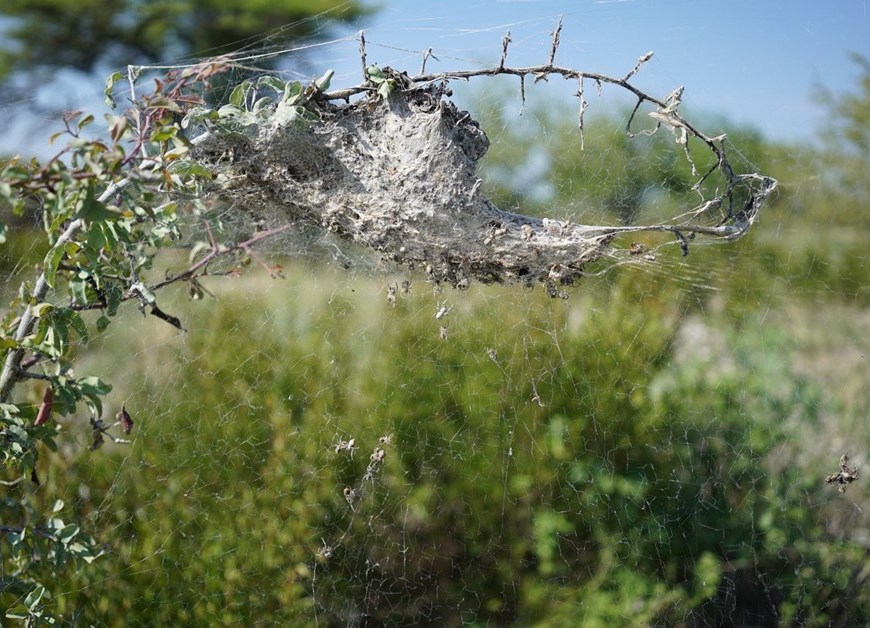
Photo: A nest of the African social spider Stegodyphus dumicola in Namibia. The nest consists of thick silk layers with multiple entry holes underneath the nest, facing the ground. A large capture web extends from the nest, and a few spiders can be seen active on the web. The spiders are predominantly inactive during the day and remain inside the nest, unless they attack prey intercepted in the web. The spiders move to the area immediate below the nest to cool down at peak summer temperatures. They are active in web maintenance activities at dusk and dawn. (Photo Trine Bilde).

Trine Bilde: Responses to thermal stress in a social spider

Trine Bilde, Professor of Evolutionary Biology in the Department of Biology at Aarhus University, discusses with us her recently accepted paper, “Behavioural and physiological responses to thermal stress in a social spider”. About the paper What’s your paper about? The study investigates behavioural and physiological adaptations to temperature stress in a desert living social spider, specifically behavioural changes in microhabitat use, and whether the wax … Continue reading Trine Bilde: Responses to thermal stress in a social spider

Luan (left) and Prof. Shirong Liu (right) visit a cloud forest close to Curitiba in Brazil during 2019 IUFRO XXV congress.

Junwei Luan: accounting for bamboo effects in soil nutrient cycling

In our new post, Junwei Luan from International Centre for Bamboo and Rattan (China) presents his last work ‘’Litter decomposition affected by bamboo expansion is modulated by litter-mixing and microbial composition’, discusses about the effects of commercial plantations in ecosystems and shares his research career experiences.   About the paper Our paper is about how a native woody grass (Moso bamboo, Phyllostachys edulis­) expansion alters forest … Continue reading Junwei Luan: accounting for bamboo effects in soil nutrient cycling

Lara Ferry

We welcome our new Executive Editor, Lara Ferry

Hello!  I am so thrilled to be able to write this post and introduce myself to you all!  Some of you have surely worked with me in the past several years as I have been a Senior Editor for the journal, Functional Ecology, for about four years now.  I am sure I will be getting to know even more of you soon.  I am excited … Continue reading We welcome our new Executive Editor, Lara Ferry

Amber Wright - Photo by Laci Gerhart-Barley

Amber Wright: Sticky toes and grippy claws

lizards use habitat in ways that match their clinging ability In this month’s cover image story we see that lizards vary in their ability to cling to different kinds of surfaces, and how this can lead to species sharing habitat.  How can lizards stick to smooth surfaces? Have you ever seen a lizard run up a window and wondered how they do it? Geckos and … Continue reading Amber Wright: Sticky toes and grippy claws