Cover Stories: Dr. Russell Bonduriansky

In this week’s blog post, Dr. Russell Bonduriansky, professor at University of New South Wales, discusses the story behind the cover for 2016’s Volume 30, Issue 10 of Functional Ecology. Russell has broad interests in evolutionary ecology, but is especially interested in the evolution of sexual reproduction and coevolution of the sexes, life history (especially ageing), and the role of nongenetic hereditary processes in evolution. … Continue reading Cover Stories: Dr. Russell Bonduriansky

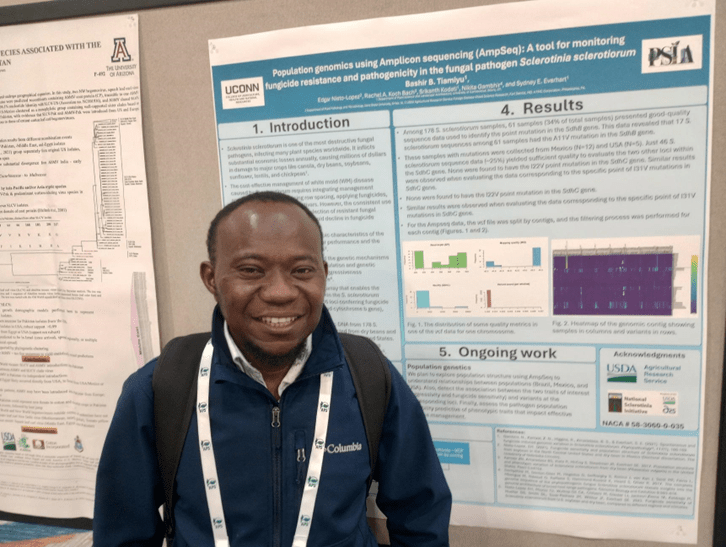
Black History Month 2024: Dr Bashir Bolaji Tiamiyu

For Black History Month 2024, the British Ecological Society (BES) journals are celebrating the work of Black ecologists around the world and sharing their stories. In this blog, Dr Bashir Bolaji Tiamiyu shares his story and journey in academia. Name: Bashir Bolaji Tiamiyu Affiliation: Ecology Interests: How did you get into ecology?I grew up in Ilorin, an urban area that is the capital of Kwara … Continue reading Black History Month 2024: Dr Bashir Bolaji Tiamiyu

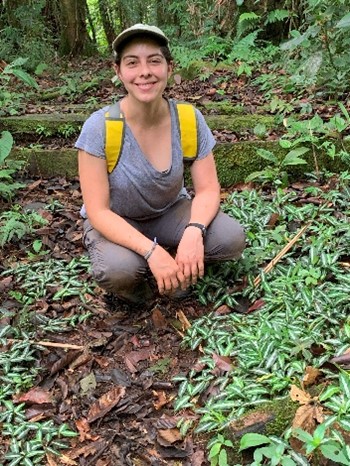
Georgia Hernández Corrales: Closely related tropical herbs have similar tolerance to high temperatures

In our newest post Georgia Hernández Corrales—PhD candidate at University of Connecticut, USA—presents her work ‘Evolutionary history constrains heat tolerance of native and exotic tropical Zingiberales’. She discusses the importance of evolutionary history for plant physiology, shares the beauty of tropical forests, and highlights the importance of mentorship for a happy start in research. About the paper Lowland forests are one of the warmest ecosystems … Continue reading Georgia Hernández Corrales: Closely related tropical herbs have similar tolerance to high temperatures

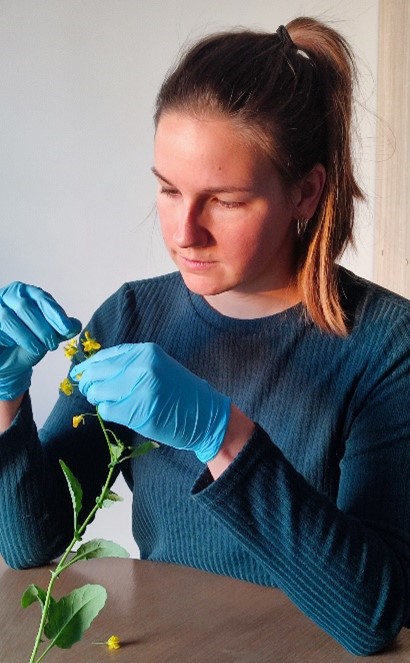
Laura Bellec: Inside the feeding behavior of a pollinivore

In this new post, Laura Bellec—a new ecological researcher working at the Univ Rennes 1, Rennes, France—discusses her paper: Factors driving the within-plant patterns of resource exploitation in a herbivore—recently shortlisted for the 2022 Haldane Prize for Early Career Researchers. About the paper Animals need to find food to survive and grow; however, searching for food is energetically expensive. Thus, animals have evolved strategies that … Continue reading Laura Bellec: Inside the feeding behavior of a pollinivore

David Villalobos Chaves: Foraging for efficiency—morphological traits provide support for variations in performance of the feeding apparatus in coexisting Neotropical bats

In this new post, David Villalobos Chaves, a PhD student at Department of Biology and Burke Museum of Natural History and Culture, University of Washington, Seattle, WA, USA, discusses his paper: Craniodental traits predict feeding performance and dietary hardness in a community of Neotropical free-tailed bats (Chiroptera: Molossidae)—recently shortlisted for the 2022 Haldane Prize for Early Career Researchers. About the paper Our research adds support … Continue reading David Villalobos Chaves: Foraging for efficiency—morphological traits provide support for variations in performance of the feeding apparatus in coexisting Neotropical bats

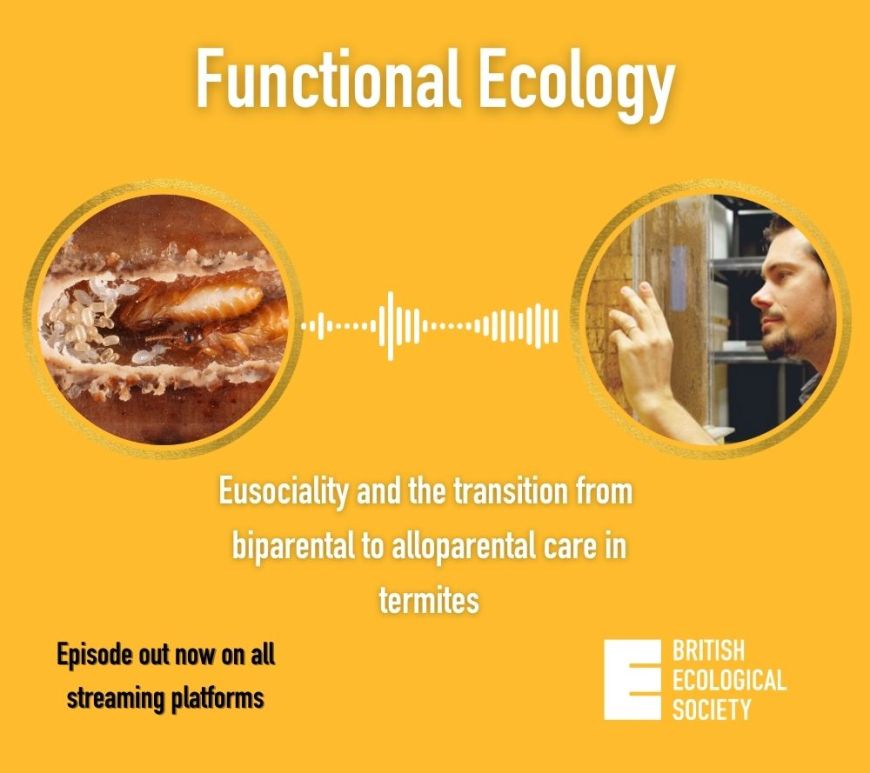
Eusociality and the transition from biparental to alloparental care in termites: Podcast Transcript

In this podcast for Functional Ecology, Assistant Editor, Frank Harris, sits down with Thomas Chouvenc—Assistant Professor at the University of Florida—to discuss his recently published paper ‘Eusociality and the transition from biparental to alloparental care in termites.’ Thomas’ paper shows that, in eusocial insects, colony foundation is a critical bottleneck, where the founding individuals must engage in a temporary (but obligatory) parental care phase that … Continue reading Eusociality and the transition from biparental to alloparental care in termites: Podcast Transcript

Carla Vázquez González: Deciphering the context-dependency of plant communication: How does drought stress affect plant-plant signalling by volatile organic compounds?

In our latest post, Carla Vázquez González—a postdoctoral researcher from the University of California-Irvine—presents her last work ‘Effect of water availability on volatile-mediated communication between potato plants in response to insect herbivory’. In this post, she sheds new light on how plants communicate to overcome adversity, discusses the striking results in her paper, and shares her thought about the rough path early-career ecologists currently face. … Continue reading Carla Vázquez González: Deciphering the context-dependency of plant communication: How does drought stress affect plant-plant signalling by volatile organic compounds?